Cricket is one of the most widely watched sports in the world, but while there has been an increase in visibility and funds in the women’s game, more can be done to make the sport inclusive at both board and grassroots levels.
This year, England and Wales will be hosting the ICC Women’s T20 World Cup, and the English and Welsh Cricket Board (ECB) will be hoping that a warm summer and a strong performance will inspire more women to pick up a bat and play.
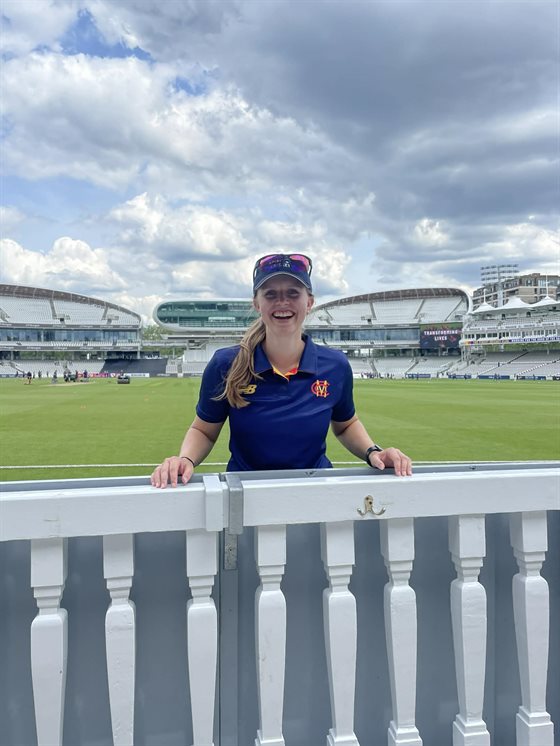
Emma Godman, who is leading the Cricket Development module on DMU's Cricket Management PG Certificate
While a good tournament could bolster participation, cricket coach and academic Emma Godman believes that academia could also play a vital role in retaining more women and creating a more inclusive culture.
Emma, who is a level 3 ECB cricket coach and plays for Wiltshire Women, is leading the Cricket Development module at De Montfort University (DMU) Leicester’s Cricket Management PG Certificate.
Having played at different levels of the game since her teens, the 29-year-old is hoping that educating the next generation of cricket leaders and professionals already working within the sport to a high level will enable them to build a more accessible sport from the ground up.
“The Independent Commission for Equity in Cricket (ICEC) highlighted inequalities across grassroots and professional levels, but for many people working in cricket, that wasn’t a surprise,” Emma said.
“Helping students understand these issues before they go into leadership roles is crucial and I think that the course at DMU can enable future coaches and administrators to spot barriers early.”
In its findings, the 2023 ICEC report was damning.
Harassment and sexism were rife and the pay for female players, both playing domestically and internationally for England, was significantly lower than that of their male counterparts.
A lack of cricket in state schools also entrenched an elitist structure with talent pathways aligned to private schools, limiting the number of players, particularly girls, accessing the game during their education.
While the ECB is working hard to ensure there are opportunities for women and girls to play – the organisation says there are 1,539 clubs with a dedicated women’s team and 1,102 with a dedicated girls’ team – many grassroots facilities are catered more towards men, with support and funding inconsistent across the country.
Emma is hoping that by learning from the game’s deep history, cricket leaders at both the professional and grassroots levels can design environments that welcome more women.
She said: “If you can go into your club and have a strong understanding of the issues that are happening – cost of equipment, access to suitable teams, a sharp drop off in girls 14-plus playing the game – then you’re on to a good start.
“There isn't a formalised cricket development focus within coach education courses" so courses like our one at DMU are really good, I think, at giving our students a full appreciation of what goes into cricket development rather than going to a club and taking up a role and just kind of figuring out then.
"If you develop your understanding in depth, with a theoretical underpinning and existing research, you can gain a full understanding of what it means to run a club or programme."
That sentiment is shared by 32-year-old Harry Warren, a civil servant who is part of the first cohort of students to study the Cricket Management PG Cert at DMU.
Worried that if he had a daughter, she wouldn’t be able to access the sport easily, Harry was inspired to create a women’s and girls’ team at Hunningham Cricket Club, just outside Coventry, where he volunteers.
Having secured money from Sport England and the National Lottery for his team, Harry enrolled on the course at DMU to understand the inclusion challenges women faced and ensure he was developing the team effectively and responsibly.
Harry said: “I’ve played cricket my whole life but I’d never had to think about how you actually create something.
“Learning with DMU has been eye-opening so far it’s given me a lot of ideas and tools to make sure I’m putting the infrastructure in place to keep the people we’ve attracted to the club.
“We were able to hire facilities, buy equipment and train coaches. We now have a female coach, which is so important for role‑modelling in a male‑dominated sport.”
“We need to make sure that money is having the most impact — more kids playing, more women playing, strengthening the infrastructure of the game.
“It’s also very important for people at the amateur level to understand governance issues, as well as equity, diversity and inclusion, to protect the investment that may be coming into the game.”
Since launching in January, 30 women aged between 12 and 65 have started training with Hunningham CC, with Harry also managing to bring in a female coach to act as a role model for the women.
Harry added: “From watching a 12-year-old girl hit the ground running and fall in love with the sport to teaching a 65-year-old woman how to bowl, it’s been so fulfilling seeing more women and girls playing the sport I love.”
The eight-month postgraduate certificate has been designed to help professionals develop a critical understanding of cricket, how the sport continually grows and development strategies from grassroots level, all the way up to the elite, international level.
Dr. Heather Dichter, Associate Professor of Sport Management and Sport History within DMU’s International Centre for Sports History and Culture and Programme Leader for the Cricket Management PG Certificate, said: “The course has been designed as professional development to help individuals already working in cricket to gain additional knowledge to benefit their own career trajectory in the sport as well as the organisation they work for. As a distance learning course, the students can study at their own pace around their work commitments.
“It’s great to see the first cohort of students see immediately apply what they have learned during their studies, even before they finish their degree.”
Posted on Wednesday 18 March 2026