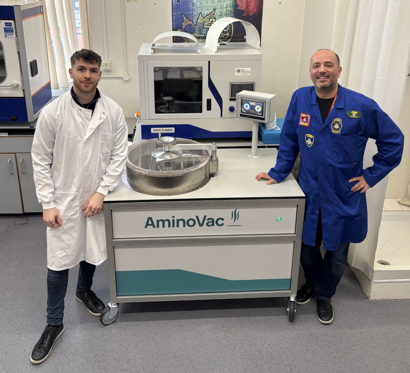
A pioneering forensic technology, called AminoVac, developed between De Montfort University Leicester (DMU) and West Technology Forensics in Bristol is moving closer to real-world use after nearly three years of research and development.
Scientists and engineers have been working together through an Innovate UK Knowledge Transfer Partnership (KTP) with West Technology Forensics to develop a new solvent-free method for detecting latent fingerprints on porous evidence such as paper.
Traditional fingerprint detection on porous items relies on chemical solutions that react with amino acids left behind in sweat from the skin. These solutions often contain per- and polyfluoroalkyl substances (PFAS), also known as “forever chemicals” because they can take decades to degrade in the environment.
The DMU/West Tech collaborative team has been working on a more sustainable and potentially cost-effective alternative.
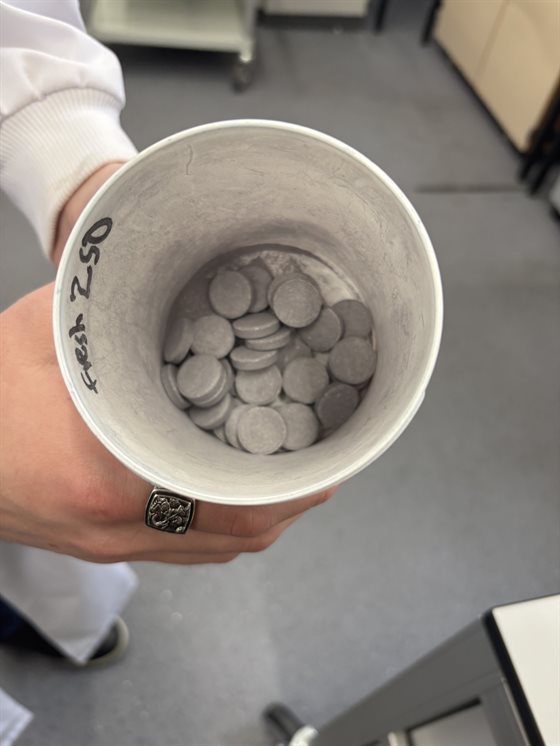
Instead of using liquid solvents, the researchers have created powder tablets containing the active fingerprint-detecting ingredients used in existing forensic techniques. These tablets are placed into a specially designed vacuum chamber known as an AminoVac, where the porous evidence is suspended inside the machine.
As the tablets heat up, vapours are released which react with the latent (invisible) fingerprints on the evidence, revealing the marks without the need for liquid chemicals. The technology is now undergoing extensive comparative trials in DMU’s forensic laboratories.
Dr Kevin Farrugia, who leads the scientific project, said the team’s aim was to rethink how the active chemicals are delivered during fingerprint detection.
He said: “The current solvent methods are used in forensic laboratories all over the world, but they rely on chemicals that are expensive and increasingly problematic from an environmental perspective. We have taken the active ingredients and delivered them in a different way.”
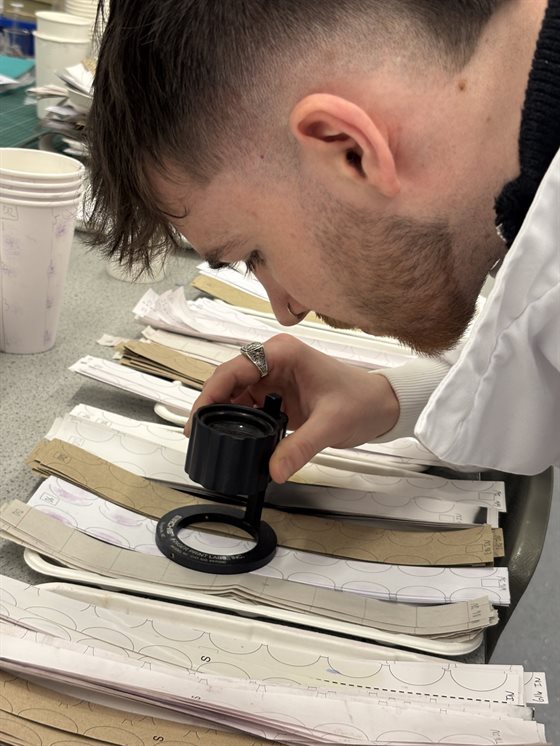
To ensure the new approach meets forensic standards, the team is carrying out rigorous testing against the two traditional amino acid detection methods - Ninhydrin and 1,2-Indandione solutions. Volunteers have provided fingerprints which are analysed across multiple types of paper, allowing researchers to study how marks appear as they gradually fade through repeated touches.
The team will analyse more than 16,000 fingerprints to see how well fingerprints can still be detected after being left on documents for days or even weeks.
If successful, the technology could help forensic laboratories address another major challenge, namely backlogs in evidence processing.
Many labs around the world face delays of several months, with documents sometimes sitting in evidence storage for extended periods. By automating parts of the fingerprint detection process, the new system could help laboratories process evidence more quickly and reduce labour-intensive chemical preparation and dangerous waste products.
Interest in the technology is already growing. Demonstrations of the system have been given to organisations including police, defence and government agencies around the world.
The project has also been a career-defining opportunity for KTP Associate Matt Needham, who joined the partnership shortly after completing a master’s degree in chemistry with forensic science at the University of Leicester.
Working between DMU’s forensic laboratories and West Technology Forensics, Matt has played a key role in developing and testing the new technology.
Matt said: "It has been a brilliant experience. I never imagined I’d be working on developing a completely new forensic technology so early in my career.”
The KTP has brought together scientists from DMU and engineers alongside industry specialists from West Technology Forensics to develop what could become a market-ready product for forensic laboratories.
Dr Farrugia added: “It’s quite rare for a KTP project to lead to a tangible physical product. We’re really excited about the progress we’ve made so far and the potential this technology has for forensic science.”
Ian Harris, Managing Director of West Technology Forensics said “The world-wide forensic community has shown an enthusiastic response to the collaboration between DMU and West Technology Forensics, with the fantastic results achieved so far, there is a real sense of anticipation for the AminoVac. When the KTP completes later this year I have no doubt it will be a highly regarded KTP project, showcasing the benefits of academia and industry working together to achieve real tangible outcomes for the forensic community.”
Posted on Tuesday 31 March 2026