MArch Architecture student Raven Schneider has been awarded a prestigious RIBA Wren Insurance Association Scholarship worth £7,500.
His project Secret Sanctuaries, which impressed the RIBA judges, proposes the conversion of a vacant office block in Leicester City Centre into community-driven housing. The project addresses the challenge of underused office space in the UK in the wake of the shift towards remote working, with ecological sustainability at the heart of his pitch.
We caught up with Raven to discuss the impact of the scholarship on his studies, his hopes for the future and the role of architects in rewilding urban spaces.
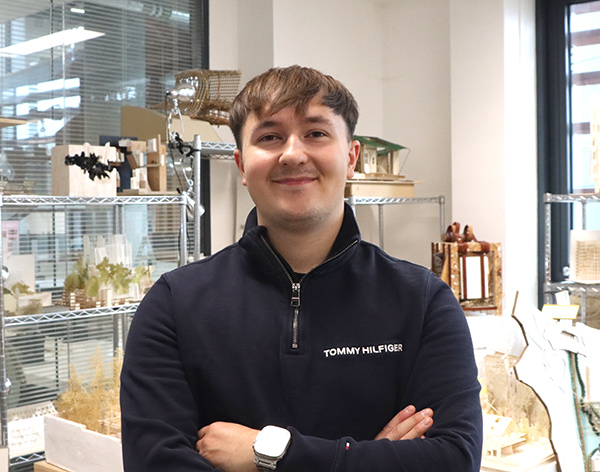
Congratulations on the scholarship, Raven! Tell us a bit more about your successful project.
Okay, so Secret Sanctuaries is a plan to refit and extend a derelict 1970s office block in the city called Leicester Crown House. Right now it’s covered in graffiti and wooden boards, but in my proposal I saw the potential for something different.
I think repurposing buildings ought to be at the forefront of people’s minds when it comes to housing in the UK. We're in a housing crisis, and we have all these resources like Leicester Crown House, which we need. But there can be a stigma about them and resistance to doing something positive with them. Instead we tend to focus on creating new buildings, which can be cost ineffective and really bad for the environment.
It's also surprisingly hard to get planning permission, especially with retrofit plans, and my project addresses issues with that. For instance, this building has had lots of plans submitted and rejected over the years.
Secret Sanctuaries includes residential flats and separate working spaces, is that right?
Yes, it’s right at the heart of my project. Personally, since Covid I think we’ve been blurring work life and home life a bit too much. Having a transition space between the two, even if its just a very short walk, can make a bit difference psychologically. Separating the two can be a real mental health bonus.
That means the walk to work, but also where you have your lunch. If you work in your bedroom, sleep there, eat there, you’re in this cycle of just being in one room and it’s not good for you.
In the past we’ve had offices and homes, and often long commutes, and that’s one extreme, but now many people are at the opposite extreme. Maybe we need to find a solution somewhere in the middle?
Sustainability is a big thing at DMU. That’s part of your MArch course and your project too, isn’t it?
Yes. We like to talk about biodiversity in cities, but knocking down a building in a built-up area and building a small park won’t help much by itself. But if you’re a bird, and you’re outside the city you’re just not going to fly 500 metres to get to this park, there needs to be more of a link – some way of introducing other species and habitats.
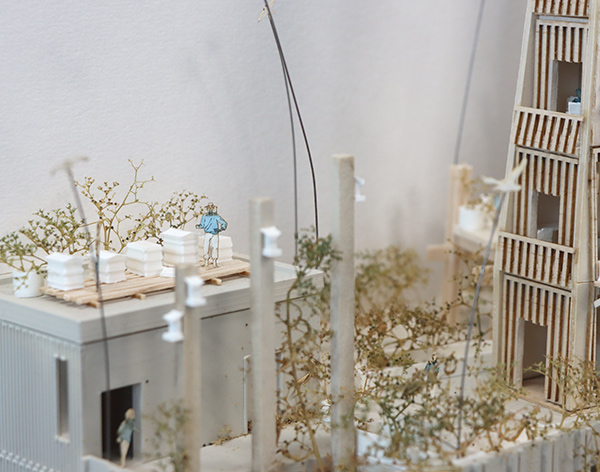
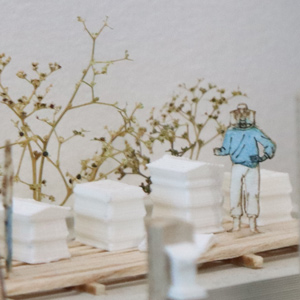 That’s where the pollinator corridors come in. We call it the wild city, and it’s part of my project – a way of bringing the rural countryside into the city. Technically every flat roof, every rooftop could turn into a little garden, and then we can have slight elements of greenery or vegetation that are linking buildings together.
And bees too. Most of us know how much of our wildlife relies on their pollination, and there’s research to say urban beekeeping can integrate really well with greenery in a city.
So that’s what a pollinator corridor is – green space for wildlife to transverse through a city. And with these things together you have a really strong base to make nature in a city thrive.
How will the scholarship benefit you?
In lots of ways, but two especially. Firstly, the medium that I use for doing my work is model making. I find that people engage much more easily with my ideas through physical models. But model making is expensive for a student - some of my models have cost up to £200, and I’ll typically make up to 20 in a year. The scholarship will really help me pursue my preferred way of representing ideas.
The other thing is the one-on-one mentoring I’ll get over the next twelve months, which will be from a member of the Wren Association. I've been able to pick a firm in London which specialises in model making, which is really fortunate. As well as my tutors, this will also enable me to get advice on my work and my career – it’s a great opportunity take my work to the next level.
How did you get into architecture and what are your future hopes?
That's a good question. As kid I always wanted to design things with my hands – I’ve always been very tactile and crafty, building Lego, things like that. Then, I did A-levels in art, physics and maths, which set me up nicely for an architecture degree. Uni wasn’t always easy, Covid was a big challenge like for lots of people. But by my third year I was loving it, and decided I wanted to do architecture permanently.
The Masters at DMU is really, really good, I’ve loved every second of it - all the tutors here are extremely high level and I feel like I've got that constant support from those who are really knowledgeable. Like I said, I want to do a lot of model making and they've completely accepted that and let me do it. It’s a really supportive course and the teaching is great.
In the long term I’d love to be part of the design team doing mostly commercial architecture, or domestic on a larger scale, and incorporating those themes I’ve been talking about. Working on retrofit projects, making sure we’re being sustainable and cost effective in what we build and repurpose. I think architects have a lot to offer in helping the construction industry become more sustainable.
Final question, is there a building you find especially inspiring?
I'm really interested in things that are well crafted, well thought through. I especially love Gaudi’s Sagrada Família in Barcelona, it’s an incredible building. There are literally millions of stones and every one was designed and tested by Gaudi himself – it’s on another level. I’d love to be in that place where every part of something I make is perfect like that. Though of course that’s not always reality.
Dr Ben Cowd is Associate Professor and one of Raven’s tutors at DMU. He reflected on Raven’s success:
“Raven is an exceptionally thoughtful and committed designer whose work demonstrates both imagination and purpose. His project Secret Sanctuaries addresses the pressing issue of redundant office buildings with intelligence and empathy, reimagining them as ecologically rich, community-focused housing. The Wren Scholarship is a fitting recognition of his design ambition, craftsmanship, and values-driven approach.
“This national award from the RIBA is a significant achievement that highlights both Raven’s design excellence and the strength of work emerging from the Leicester School of Architecture.”
The last time a DMU student received a Wren scholarship was in 2015, when Alex Mills impressed with a portfolio including pieces on Italian Baroque-themed buildings. Alex is now a practicing architect in London and teaches on the MArch Architecture programme.
Find out more about the MArch Master’s course at DMU.
Posted on Wednesday 3 December 2025