De Montfort University Leicester (DMU) has highlighted how universities can help turn research, skills and regional partnerships into practical support for innovation and economic growth.
The UK Global R&D and Science Investment Summit, held at The Royal Society in London on 8 and 9 June during London Tech Week, explored how research, investment and regional partnerships can help drive productivity and growth across the UK.
Chaired by UK Government Chief Scientific Adviser Professor Dame Angela McLean DBE FRS, the summit brought together a specially invited audience of global investors, industry leaders, researchers and innovators.
DMU Vice-Chancellor Professor Katie Normington attended as part of the Midlands university community and spoke at the summit welcome reception to introduce Lord Patrick Vallance, the Minister of State for Science, Innovation, Research and Nuclear.
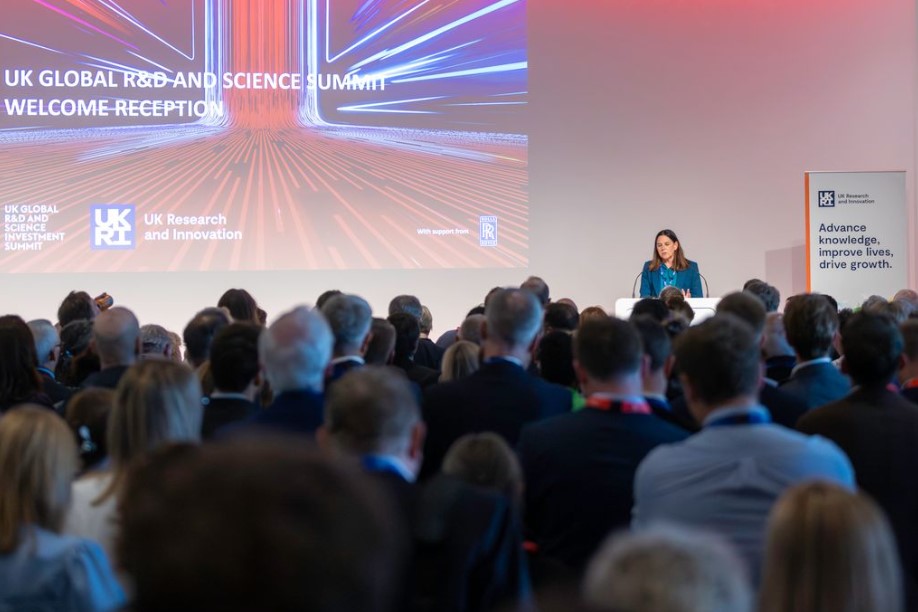 Photo: Alex Wilkinson
DMU also contributed to discussions spanning university innovation, regional growth and cyber resilience, including an invite-only roundtable led by Dr Ismini Vasileiou, Associate Professor at DMU and Director of the East Midlands Cyber Security Cluster.
The session, Beyond Policy to Place: Building the Delivery Infrastructure for Cyber Resilient Growth, explored how national cyber, digital and industrial strategies can be translated into practical support for businesses, sectors and regions.
Representatives from Innovate UK, the Department for Science, Innovation and Technology, the National Cyber Security Centre, BT, and other organisations involved in delivering the UK’s Cyber Growth Action Plan took part in the discussion.

The roundtable focused on how small and medium-sized enterprises can navigate growing cyber security requirements, develop workforce skills and strengthen resilience. Topics ranged from cyber skills shortages and emerging technology requirements to the practical challenges businesses face in meeting cyber security standards.
Cyber resilience is increasingly becoming a requirement for organisations seeking to secure contracts and participate in supply chains, with certifications such as Cyber Essentials often acting as a gateway to new business opportunities.
Dr Vasileiou said: “A key theme throughout the discussion was the need to bridge the gap between national policy and practical implementation for businesses.
“While there is lots going on at policy level, SMEs often need support to understand what these developments mean in practice and how they can respond.
“Cyber resilience is no longer simply a technical issue. It is becoming an essential business capability that can influence competitiveness, growth opportunities and access to markets.
“Universities are uniquely positioned to bring together research, policy and industry. By working with businesses and partners, we can help organisations understand emerging challenges, develop capability and access the knowledge they need to grow with confidence.”
The session built on work by DMU and the East Midlands Cyber Security Cluster, supported by the Department for Science, Innovation and Technology, which has been submitted to the Cabinet Office as an impact case linked to the UK’s wider industrial strategy.
Professor Normington said the summit was an opportunity to show how universities can help turn research and ideas into practical impact for places, employers and communities.
She said: “Universities are a vital part of that story. We generate research and ideas, but we also connect them to people, places, employers, skills and communities.
“At DMU, that mission is rooted in Leicester, and now extends through our campuses in Dubai and, from this year, London. Our own contribution includes skills, creative industries, cyber, enterprise and inclusive growth.
“For investors and partners, clarity matters. So do trust, confidence and routes into collaboration. Universities have an important role in making those connections easier, and in helping investment land in ways that benefit places, sectors and communities.”
The summit formed part of the Invest in UK University R&D – Midlands Campaign, a two-year pilot programme designed to demonstrate how a coordinated, place-based approach can attract international investment into UK research and innovation.
The wider programme included speakers, roundtables and networking with senior representatives from across global science, industry and investment, with themes including industrial strategy, regional innovation, university spinouts, venture capital, clean technology, deep technology and life sciences.
The event was one of a series run by Midlands Innovation, which brings together universities across the region to showcase spin-out companies and innovation across sectors including advanced manufacturing, health and med-tech, clean energy, digital technologies and aerospace.