An new artificial intelligence system capable of predicting how much water is held in soil could help farmers protect crops and use increasingly scarce water supplies more efficiently as the world becomes warmer.
An international research team, led and supervised by Associate Professor Mujeeb Rehman of De Montfort University Leicester (DMU), has used in-situ field sensors, cloud computing and deep learning to create a real-time soil-monitoring and prediction system.
The technology could eventually help farmers decide more precisely when crops require water, reducing both unnecessary irrigation and the danger of plants being damaged because water was supplied too late.
Its development comes as climate change places increasing pressure on food and water systems. The Intergovernmental Panel on Climate Change says human-induced warming has already contributed to increasing aridity and agricultural drought in some regions, with drought expected to affect more regions as global temperatures rise. Agriculture currently accounts for around 70 per cent of freshwater withdrawals worldwide.
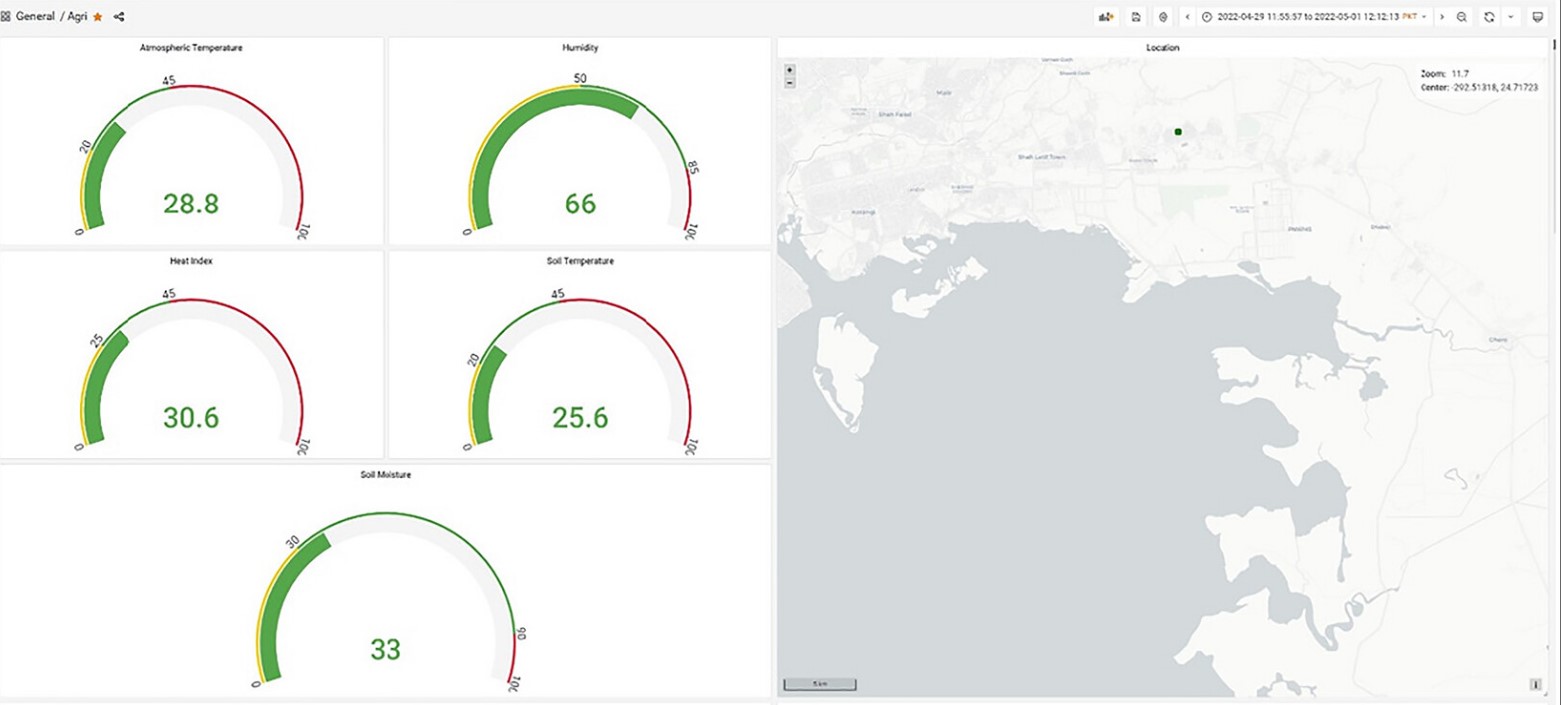
Grafana visualization of real-time measurements and Global Positioning System (GPS) location.
The World Meteorological Organization has confirmed that the years from 2015 to 2025 were the 11 warmest on record, while 2025 was around 1.43°C warmer than the average recorded between 1850 and 1900.
Dr Rehman, from DMU’s School of Computer Science and Informatics, who supervised the research, said: “Farmers across the world are facing the difficult challenge of producing more food while coping with higher temperatures, less predictable rainfall and growing pressure on freshwater supplies.
“Watering crops too little or too late can reduce yields, but unnecessary irrigation wastes a resource that is becoming increasingly precious. By giving farmers a clearer picture of what is happening beneath the surface of their fields, artificial intelligence could help them make better and more timely decisions.
“This technology will require much wider testing before it can be deployed commercially, but it demonstrates how intelligent monitoring could help agriculture become more productive, efficient and resilient in a warming world.”
The system uses sensors connected to a small ESP32 computer to collect information including soil moisture, soil temperature, air temperature, humidity, heat index and geographical location.
Data are transmitted through Wi-Fi and processed using cloud-based technologies capable of handling large and continuous streams of information. Farmers or agricultural managers could view current conditions and predictions through an online dashboard.
Researchers then used a hybrid artificial intelligence model combining two forms of deep learning known as long short-term memory and gated recurrent unit networks. These are designed to recognise patterns within information collected over time and use them to forecast what is likely to happen next.
Approximately 72,000 readings were gathered at intervals of around 15 seconds between 28 April and 13 May 2022.
The combined AI model produced predictions that closely matched the recorded soil-moisture measurements. It reduced one measure of prediction error by approximately 1.6 per cent compared with a conventional long short-term memory model, while another measure improved by around 3.2 per cent.
Although the improvement was relatively small, the researchers say it was consistent and shows the potential value of combining different forms of deep learning within one agricultural monitoring system.
Unlike many existing smart-farming systems, which collect information but leave people to interpret it, the new framework is designed to turn data into predictions that could support practical decisions.
In future, systems of this kind could potentially be linked to irrigation equipment, allowing water to be directed to crops when and where it is most needed. However, the research did not directly test water savings, crop yields or an automated irrigation system.
The researchers also caution that the current study is a proof of concept. Although it gathered a large number of readings, they came from one location during a period of just 15 days.
Longer trials will be needed across different crops, soil types, seasons and climates—including periods of extreme heat and drought—to establish how well the system performs under real farming conditions.
Future developments could include processing information directly at the farm rather than sending everything to the cloud, using 5G networks to improve connectivity and developing explainable AI systems that show farmers why particular recommendations have been made.
The study, It involved researchers from DMU, Pakistan’s National University of Sciences and Technology and Iqra University, as well as Princess Nourah Bint Abdulrahman University and King Khalid University in Saudi Arabia.
Posted on Friday 31 July 2026