A ground-breaking scientist from De Montfort University Leicester (DMU) has been honoured at the House of Lords for his work tackling global health challenges from malnutrition to arsenic contamination in food and water.
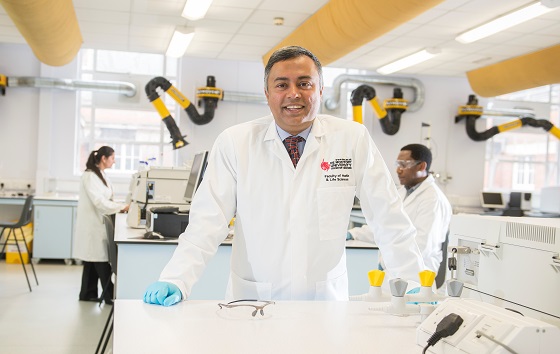
Professor Parvez Haris, Emeritus Professor of Biomedical Science was among the recipients of the 2026 Bengal British Icon Awards, held at the House of Lords in London this summer.
The awards recognise outstanding achievement by people from across the global South Asian diaspora in fields including education, healthcare, business, media and public service.
Professor Haris has built an international reputation for research into the relationships between food, pollution, nutrition and human health.
Much of his work has focused on the highly-toxic element arsenic, which can enter the food chain through water, soil and crops.
His research has shown how eating rice can contribute to arsenic exposure, particularly among people for whom rice is a large part of the diet, and he has helped identify varieties of aromatic rice which contain lower levels of arsenic.
Professor Haris has also investigated ways of removing arsenic and other toxins from contaminated water, including research showing that the water hyacinth plant can absorb pollutants from water, including from a highly polluted river in Wales.
Professor Haris said: “I was honoured to receive this award at the House of Lords for my research in the field of Biomedical Science.
“All this has been possible thanks to the world-class facilities and research support at De Montfort University that gave me the freedom to carry out high-impact research to address global health challenges, ranging from clean water to nutritious and safe foods.”
His renowned work includes his ongoing work as Principal Investigator on the HealthyDiets4Africa - a six-year, multi-million-euro Horizon-funded project to develop healthier, safer and more sustainable food systems in eight African countries.
His international research standing has been recognised through global citation rankings, including a Stanford University-led analysis placing him among the world’s most highly cited scientists and recognition from ScholarGPS as a Highly Ranked Scholar.
Professor Haris is a Fellow of both the Royal Society of Chemistry and the Royal Society for Public Health.
Posted on Friday 14 August 2026