A neurodivergent De Montfort University Leicester (DMU) academic has won one of higher education’s most prestigious teaching awards for pioneering work that uses artificial intelligence to help universities understand and support their students more effectively.
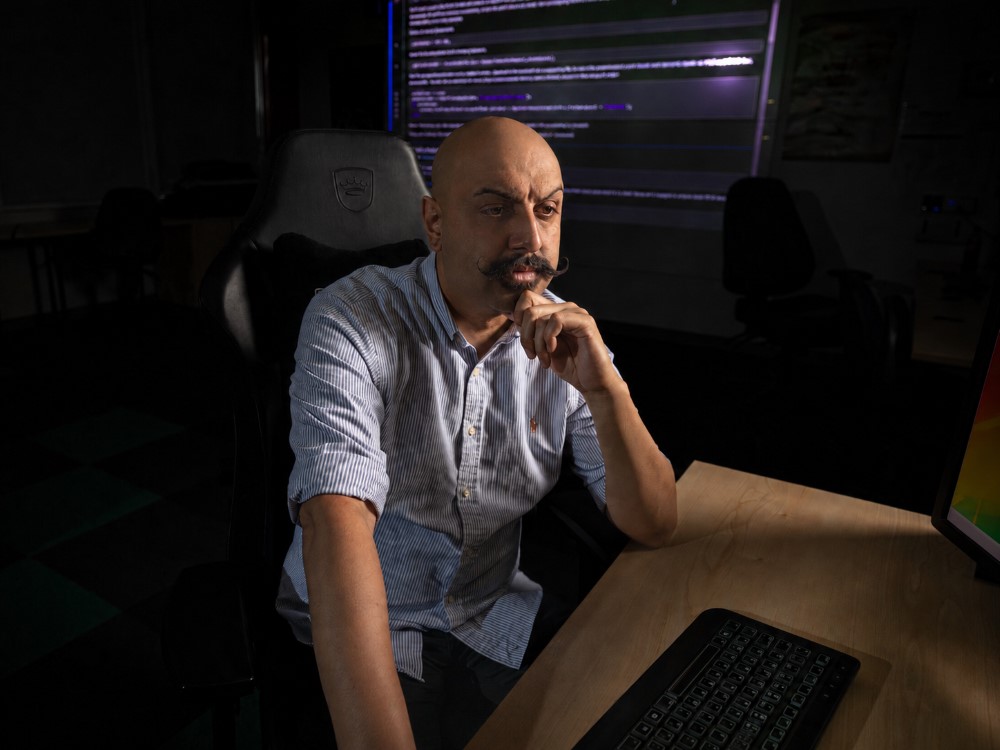
Dr Archie Khuman, Associate Head of Education in DMU’s School of Computer Science and Informatics, has been awarded a National Teaching Fellowship.
The fellowships recognise individuals who have made an outstanding and sustained contribution to student outcomes and the teaching profession. Nationally, just 55 are being awarded in 2026 by Advance HE, a charity dedicated to improving higher education for staff, students and society.
Dr Khuman’s work uses AI and learning analytics in two closely connected ways: to help academic teams spot emerging difficulties before students reach crisis point, and to create learning resources that work for a wider range of students.
At the heart of the first strand is his Insight and Understanding Framework, which brings together information about attendance, engagement, assessment submissions, attainment and progression.
Rather than looking at any single measure in isolation, the framework helps academic teams see a fuller picture of what students may be experiencing and identify patterns that could require attention.
Dr Khuman said: “Universities hold a great deal of information about the student experience, but the real value lies in bringing those different pieces of information together and understanding what they are telling us.
“A student’s attendance, engagement or assessment performance should not be viewed in isolation. Each is only one part of a much more complex picture.”
The framework is designed to move student support away from being predominantly reactive. Instead of waiting until a student has failed an assessment, withdrawn or asked for help, staff can identify emerging signs of difficulty and consider an appropriate response.
That might involve academic contact, structured follow-up, additional learning support, clearer assessment guidance, changes to curriculum pacing or resources that explain difficult material in a different way.
Crucially, Dr Khuman said the technology is not being used to label students or make automatic decisions about their futures.
“The purpose is not to label students or predict failure,” he said. “It is to understand where students may be encountering difficulty and give colleagues the insight they need to respond more thoughtfully and proportionately.”
Dr Khuman reviews and interprets the information before sharing focused insights with programme leaders and teaching teams. Those colleagues then bring their own knowledge of the students, subject and learning environment to deciding what action, if any, should be taken.
He said: “The framework turns data into a conversation.
“The technology gives us greater insight, but it is the informed and compassionate action taken by colleagues that makes the difference.”
The framework can also distinguish between an issue affecting one student and a wider pattern across a module, programme or cohort. This allows immediate support to be better targeted while also informing longer-term decisions about teaching, curriculum design and assessment.
The Insight and Understanding Framework is now embedded across programmes in DMU’s School of Computer Science and Informatics, which supports more than 2,300 students across more than 20 programmes and involves over 90 academic staff.
Its phased introduction has coincided with sustained improvements in student engagement and continuation, alongside reductions in deferral applications and academic practice offences.
A second strand of Dr Khuman’s work explores how AI can help educators adapt established teaching resources for students with different needs and learning preferences.
The academic content, intended learning outcomes and standards remain unchanged. What changes is the route through which a student encounters the material.
A concept could, for example, be presented through a written explanation, practical example, visual representation, structured activity or problem based on a context that connects more effectively with the learner.
Dr Khuman said: “Personalisation is not about making the subject easier or reducing academic expectations. It is about creating more than one meaningful route into the same challenging material.
“The destination and the academic standard remain the same, but the route can be different.
“Sometimes a student is entirely capable of understanding the material, but the way it was first presented did not connect with how they process information. AI gives educators another way to adapt carefully designed resources so that more students can reach that moment when the concept finally clicks.”
The approach is particularly relevant within a school teaching subjects including computer science, artificial intelligence, cyber security, data analytics and games development, where students arrive with widely differing educational backgrounds, experiences and learning preferences.
Dr Khuman’s own experience as a neurodivergent student and academic has strongly influenced his thinking about teaching and inclusion.
He said: “My neurodivergence is an important part of how I see education. It has made me very conscious that ability and potential are not always revealed by a standardised learning experience.
“Inclusion should not be something added after a student has struggled. It should be designed and embedded from the beginning.”
The support he is now helping to develop is the kind of help he says could have made a significant difference when he was a student himself.
Dr Khuman first came to DMU as a Computer Science undergraduate in 2005. He went on to complete a master’s degree in Intelligent Systems and a PhD in Computer Science at the university before joining its academic staff in 2017.
“I am incredibly proud to be a product of De Montfort University,” he said. “I completed my undergraduate degree, MSc and PhD here before joining as an academic.
“That journey has given me a deep understanding of the institution and the students it serves. It has also given me the opportunity to help create some of the changes that would have made a real difference to me as a student.”
His contribution has already received sustained recognition from DMU students. Dr Khuman has won a record five DMU Students’ Choice Teaching Awards, in 2018, 2019, 2021, 2023 and 2024.
In 2022, he was also awarded a DMU Teacher Fellowship following a competitive assessment of his teaching, educational innovation and impact. The fellowship, now known as an Education Academy Fellowship, was renewed in 2025.
Although his current role is no longer primarily classroom-based, it allows him to influence teaching and student support across an entire school.
He said: “Teaching excellence is not confined to what happens during a single class. It is also about creating the conditions, environment and culture that allow excellent teaching and meaningful support to happen consistently.
“My role now gives me the opportunity to work alongside colleagues across the, School, faculty and institute, turning insight into practical action and helping effective practice reach many more students.”.”
Dr Khuman’s National Teaching Fellowship recognises a contribution that brings together artificial intelligence, academic research, educational leadership and his own lived experience.
His work is helping academic teams understand students more fully, intervene earlier when support may be needed and create different routes into challenging material, giving more learners the opportunity to fulfil their potential.
Posted on Thursday 6 August 2026