A teaching idea developed at De Montfort University Leicester (DMU) is now being showcased internationally by global business giant Bloomberg Education.
DMU has an ongoing relationship with Bloomberg, the global provider of financial data, news and analytics, and the university uses the company’s huge range of information in its teaching, including through the Trading Floor - DMU’s state-of-the-art financial simulation facility.
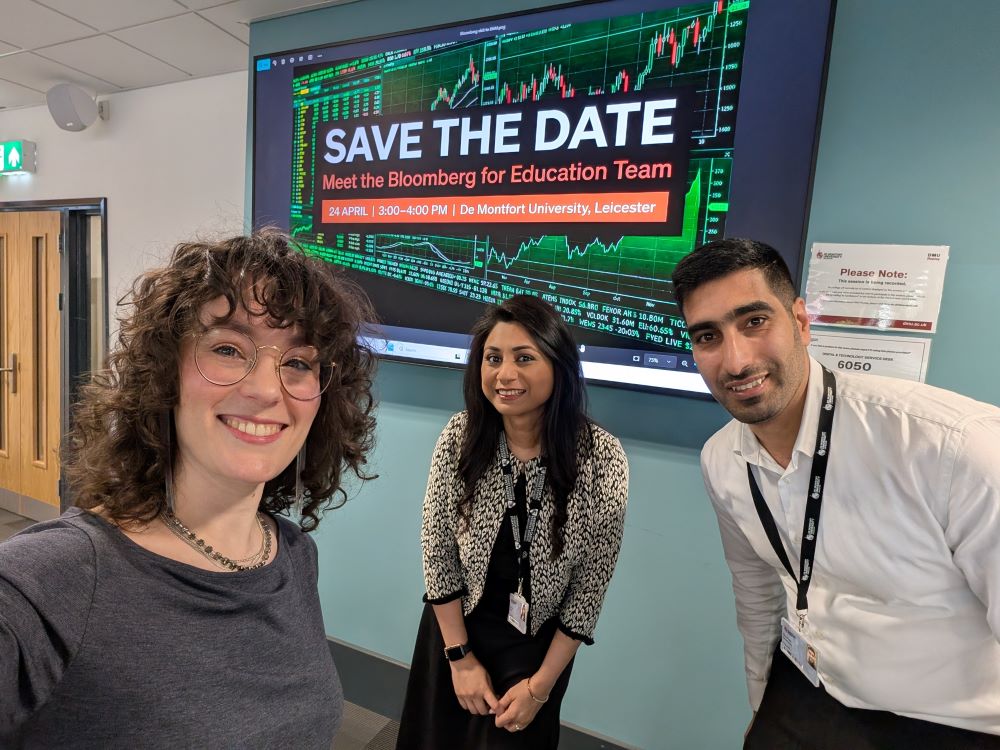 Dr Irina Gokh, Dr Meryem Altaf and Dr Mohannad Elmanaseer of DMU.
Now academics at DMU’s Faculty of Business & Law have gone beyond the conventional use of Bloomberg’s data to explore how its live and historical data streams can be used across subjects ranging from sustainability and international relations to human resources, marketing, crisis management and entrepreneurship.
Dr Irina Gokh, Associate Head Education at DMU, devised a special Bloomberg hackathon in which she challenged 14 of her DMU colleagues to spend just two hours exploring the Bloomberg Terminal to create a new teaching activity based on their own specialist subject.
Bloomberg was so impressed by the resulting DMU Hackathon Showcase that the company decided to publish the 38 page document on its portal for educators, allowing academics internationally to explore the ideas.
Dr Gokh said the format was deliberately different from a conventional training workshop, where academics might learn how to use a system but leave without having created anything of their own.
She said: “I didn’t want to make it a workshop because you have to own the bit at the end. You need to have the courage to say, ‘This is what I’ve done.’”
The 14 cases demonstrate just how widely Bloomberg’s data can be applied.
One case uses vessel movements and refinery locations to help students investigate supply-chain management, while another uses global natural gas pipeline data to explore the complexities of major international projects.
Another places students in the middle of a geopolitical crisis at the Strait of Hormuz, using Bloomberg news, live vessel movements, oil-market information and company data to examine how disruption at one of the world’s most important shipping routes can ripple through commodity prices, inflation, supply chains and individual businesses.
Other academics developed activities examining the impact of extreme weather on factories and infrastructure, corporate sustainability and ethics, gender diversity in the workforce, branding, international trade and entrepreneurship.
Dr Gokh said the aim was not to turn academics or students into Bloomberg experts, but to use its enormous pool of real-world information as a way of getting them to ask better questions and make evidence-based decisions.
In the Hackathon Showcase she describes the idea as allowing academics to use their own disciplinary expertise to turn the Bloomberg Terminal into a “decision-making lab”.
She said: “To me, real creativity is problem solving. It’s about: can you first say what the problem is? Can you name that problem? Can you identify the questions that really need to be answered? Can you find ways of solving the problem?”
That ability to demonstrate how a conclusion has been reached is becoming increasingly important, she believes, as artificial intelligence changes the skills employers expect from graduates.
Dr Gokh added: “Our students, when they go to the interview, no one is going to ask them to tell me, ‘What do you think about that theory?’ They’re going to ask them to show their thinking.”
The Bloomberg Hackathon Showcase features contributions from academics working across supply chain management, project management, international trade, international relations, organisational resilience, business strategy, sustainability and ethics, human resource management, branding, crisis and risk management, marketing and entrepreneurship.
Dr Gokh worked with colleagues Meryem Altaf and Mohannad Elmanaseer to facilitate the hackathon, helping academics navigate Bloomberg’s thousands of functions and identify the relatively small number of tools most relevant to their individual disciplines.
The initiative forms part of a growing relationship between DMU and Bloomberg for Education, which has also seen Bloomberg specialists work with academics and students at the university and DMU London students visit Bloomberg’s European headquarters in the City of London.
The publication of the showcase means ideas developed in a two-hour session at DMU can now be shared with educators much further afield – demonstrating how data more commonly associated with financial markets can be turned into practical teaching across a much wider range of business subjects.
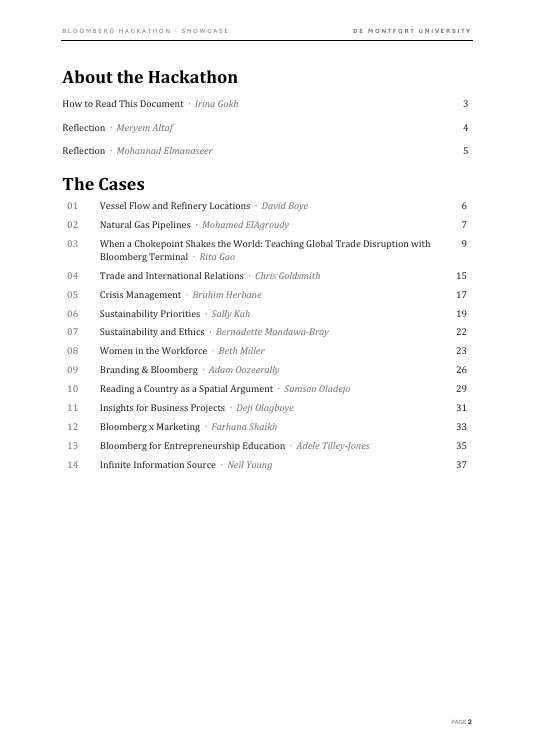
Content page from the Hackathon poublished by Bloomberg Education
Posted on Tuesday 15 September 2026