New high-tech fabrics could soon mean that wearing sports clothing will be like "having a smartwatch across your whole body", according to an innovative engineer from De Montfort University Leicester (DMU).
Dr Hafiz Muhammad Asad Ali is part of an international research team examining how flexible supercapacitors could be incorporated into sports clothing, allowing fabrics to store electricity and power sensors capable of continuously monitoring the person wearing them.
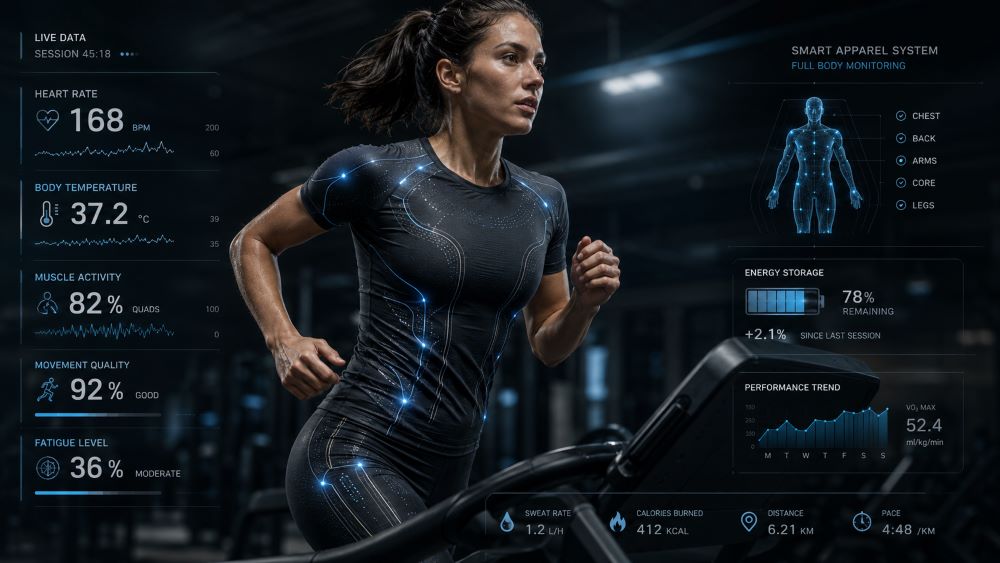
Combined with technology capable of generating electricity from sources such as body movement or heat, the approach could ultimately lead to running tops, cycling kit and gym wear which generate and store their own energy to power performance-monitoring technology.
And Dr Ali believes the potential goes well beyond sport. Similar smart fabrics could eventually be used in healthcare, allowing clothing to continuously collect information from different parts of a patient’s body and potentially provide doctors and nurses with a much more detailed picture of their health.
Dr Ali said: “The easiest way to think about it is like a smartwatch, but across your whole body.
“A smartwatch can give you information such as your heart rate; smart clothing could potentially give you information from across the body.”
For athletes, that could mean clothing monitoring information such as heart rate, body temperature, muscle activity, movement and fatigue while they run, cycle or train.
Instead of relying on a single smartwatch or fitness tracker worn on the wrist, sensors incorporated throughout a garment could potentially collect information from different areas of the body and communicate it in real time.
In healthcare, Dr Ali envisages similar technology being used to monitor patients.
He said: “In a hospital, the potential is for doctors or nurses to be able to access information from the clothing a patient is wearing, rather than having to carry out every measurement manually.
“That could include information such as body temperature and differences in blood pressure across the body.”
The new study, Supercapacitor in Sports E-Textiles for Sustainable Gym and Running Apparel, reviews developments in supercapacitor technology and how they could be applied to gym and running clothing.
Supercapacitors perform a similar energy-storage role to batteries but can charge and discharge very rapidly. Crucially for smart clothing, they can also be made lightweight and flexible enough to bend and stretch with fabric.
Knitted fabrics and conductive yarns are among the most promising approaches because they offer the potential to combine electrical performance with the flexibility, stretch and breathability needed in sportswear.
Carbon-based materials including graphene and carbon nanotubes also show potential because they can store electrical energy while remaining sufficiently flexible to be incorporated into clothing.
Dr Ali’s contribution to the research centred on its conceptual framework – examining how developments across different areas of engineering can now be brought together to create new types of smart garment.
Dr Hafiz’s research focuses on metamaterials, a new generation of engineered materials with tuneable properties that are not readily achievable using conventional materials. This research enables the design and fabrication of innovative smart e-fabrics with tailored mechanical and functional properties for next-generation applications.
He said: “Different technologies are now reaching the point where they can be combined.
“We have advances in electronics, material science, manufacturing and smart, flexible fabrics, and when we bring those things together it opens up a whole new direction for smart garments.
“The clothing itself can potentially communicate with other technology and provide information about the person wearing it.”
Significant challenges still need to be overcome before such clothing becomes an everyday reality.
Electronic fabrics would need to withstand sweat, repeated stretching and bending and regular washing without losing their performance. They would also have to remain comfortable and breathable and eventually be capable of being manufactured affordably and at scale.
Sustainability is another important consideration. The study highlights the potential for recyclable and biodegradable materials, greener manufacturing processes and garments designed so electronic components can eventually be recovered rather than becoming another source of electronic waste.
The research sets out the technological framework rather than presenting a finished smart garment, but Dr Ali hopes it can now lead to practical development.
He said: “This paper provides the conceptual framework. The next stage is to seek funding to develop the technology, and from there we can work with other researchers, university departments and companies to take the idea forward.”
The study was published in the journal Micro. It was co-authored by Dr Muhammad Umar Fareed, of Stoke-on-Trent College; Ahmad Fraz, of the University of Management and Technology in Lahore, Pakistan; Dr Nesrine Amor and Dr Muhammad Tayyab Noman, of the Technical University of Liberec in the Czech Republic; and Dr Musaddaq Azeem, of Leicester-based Green Energy and EPC Services Ltd
Posted on Thursday 3 September 2026