A senior official at the UN's World Health Organization has backed calls by a De Montfort University Leicester (DMU) lecturer for the UK to recognise the toll of death and serious injury on Britain's roads as an urgent public health issue.
Dr Etienne Krug, Director of Health Determinants, Promotion and Prevention at the World Health Organization (WHO), has written in support of Meera Naran MBE, a Senior Lecturer in Clinical Pharmacy at DMU, and her campaign to bring health, transport and other sectors together to prevent deaths and serious injuries on Britain's roads.
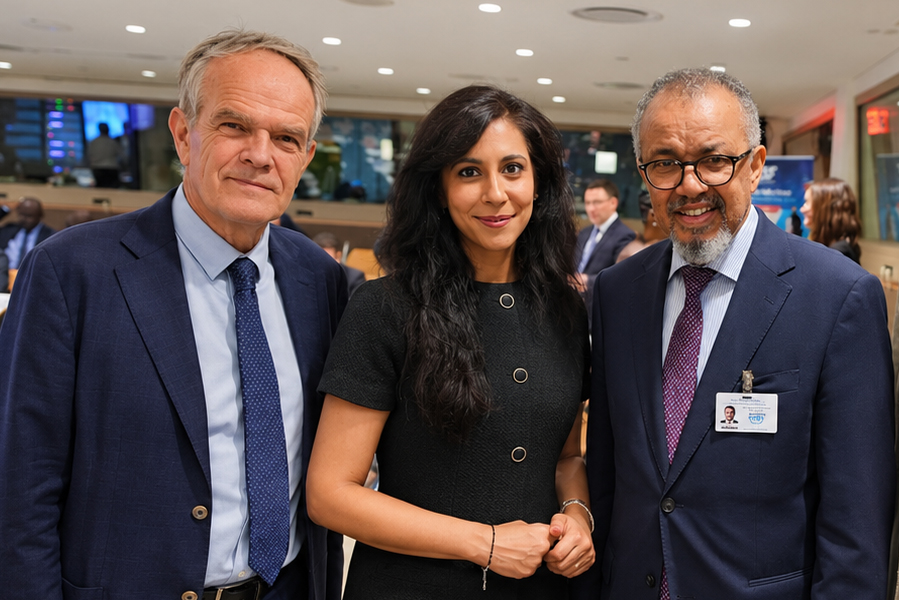
From L to R: Dr Etienne Krug, WHO Director Health Determinants, Promotion and Prevention Department, Meera Naran MBE, and WHO Director-General Dr Tedros Adhanom Ghebreyesus.
The international endorsement is particularly significant for DMU in its role as the United Nations Academic Impact Global Hub Chair for Sustainable Development Goal 11 (SDG 11) – Sustainable Cities and Communities.
One of the specific targets of SDG 11 is to improve road safety and provide safe, affordable, accessible and sustainable transport systems for all. Meera's campaigning is an example of how the university's expertise and engagement with policymakers can help turn that ambition into practical measures to save lives.
The link is particularly timely as the COP31 UN climate conference is currently taking place in Turkey. Sustainable transport and resilient cities are among the themes on the agenda, reflecting the wider UN ambition to create transport systems that protect both people and the environment.
For Meera, the campaign is deeply personal. Her eight-year-old son Dev was killed in May 2018 when a lorry crashed into the back of a stationary car on a stretch of smart motorway near Birmingham.
Since then, Meera has dedicated herself to improving road safety, helping to influence national policy on road safety initiatives, vehicle technology, and driver education.
Her latest campaign seeks formal recognition that deaths and serious injuries on the roads are not simply a transport problem, but a public health issue that requires coordinated action across government, the NHS, emergency services, academia and industry.
In his letter, dated 19 October, Dr Krug states: "Road trauma cannot be viewed solely as a transport issue."
He explains that its consequences are borne not only by those directly involved and their families, but also by health services, emergency services, communities and economies.
He praises Meera's efforts to bring together expertise from public health, academia, healthcare and road safety, arguing that greater collaboration can strengthen the evidence needed to prevent deaths and serious injuries.
Dr Krug concludes: "I am therefore very pleased to support Meera's campaign and its ambition to see road deaths and serious injuries formally recognized as a public health issue in the United Kingdom."
Meera said: “I am deeply honoured to receive this letter of support from Dr. Krug and grateful for his lifelong commitment to road safety. I believe that formal recognition could strengthen cross-sector and cross-departmental collaboration, promote prevention and early intervention, and support evidence-based policy, practice, and research.
“This initiative would help align efforts across organisations and disciplines, support the NHS 10-Year Health Plan, wider government priorities, and contribute to achieving the ambitions set out in the Road Safety Strategy.”
“I have no doubt that the Government is committed to doing the right thing.” she added.
In January this year, the Government pledged to introduce Dev's Law, named in memory of her son, as part of plans to require 18 vehicle safety technologies, including advanced emergency braking systems.
Meera, who was awarded an MBE for services to road safety, has also campaigned successfully for CPR and defibrillator education for learner drivers and addressed international road-safety events hosted by the WHO and United Nations.
Dr Krug also welcomes the Government's 2026 Road Safety Strategy, particularly its commitment to link police-recorded collision data and healthcare data to improve understanding and prevention of road deaths and serious injuries.
This approach reflects the ambitions of DMU's SDG 11 Hub, which promotes collaboration and knowledge exchange to make cities and communities safer, more inclusive and sustainable.
According to the Parliamentary Advisory Council for Transport Safety (PACTS), more than 30,000 people are killed or seriously injured on UK roads every year – equivalent to the entire population of a town the size of Kendal in Cumbria.
The organisation estimates the annual economic and societal cost of road collisions at more than £55 billion, including lost productivity, medical costs and the human cost of death and injury. The Government's Road Safety Strategy, published in January 2026, estimates that medical and ambulance costs alone amounted to £3.1 billion in Great Britain in 2024.
Posted on Thursday 12 November 2026