Ketan Ruparelia has been awarded full membership of the Leicester Institute for Pharmaceutical and Health Innovations, the first De Montfort University technician to attain that status.
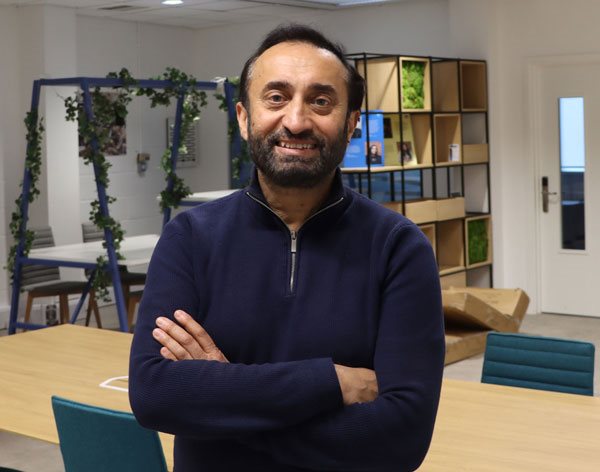
A veteran DMU technician of 36 years, Ketan Ruparelia has surely had one of De Montfort University’s (DMU’s) most varied careers. From hands-on lab support in his early years at Leicester Polytechnic, he has progressed through study and teaching into research, contributing to more than 50 peer-reviewed publications, patents and international conference presentations. His research in cancer drug discovery includes work on Banoxantrone™, now in clinical trials, and he has been shortlisted for a Times Higher Education Award.
Ketan’s role includes student support, from being an approachable figure in the lab to leading DMU Global trips, with his technical skills coming to the fore during university open days where he can be seen making ice cream from liquid nitrogen. He’s also a pioneer. As he explains, his successful application is a real step forward in his aim of bridging the traditional divide between technical and academic roles.
It's great to talk to you, Ketan. Can you talk a little bit about your career journey?
Yes, of course. I came to DMU in November 1990 after graduating from Nottingham Trent (then Nottingham polytechnic) in Applied Chemistry. I came as a technician on a temporary contract, thinking it would be a stepping stone to a permanent job elsewhere, but I’ve ended up staying here for 36 years!
At the time I was working with a professor called Jerry Potter, who moulded me into part of his group, and over time I was able to do my Master’s, then my PhD alongside my work. I did my PhD in cancer research - I really wanted to do something that had an impact on the world.
The PhD, and also a PGCert I did, opened doors for me to teach on postgraduate courses. I’ve ended up being almost an academic without being called an academic, my official title is Technical Instructor.
But all these barriers I'm hoping to bring down, because the university is committed to something called the Technician Commitment, which brings more visibility and recognition for technicians. Often, we’re just seen as people who clean benches or sort chemicals, but we do much more than that – over the last few years with the Technician Commitment I’ve really seen things change.
In my career, I feel I’ve taken the opportunities that have been open to me, which have allowed me to flourish in my work. I’ve done my normal day duties, and also my research, and collaborated with academics. I have a mindset that where there's an opportunity, I dive in, and I think that's made my job much more interesting. With DMU, I’ve found that if you have an interest you want to pursue, they can be really encouraging about that.
Congratulations on your successful application! How did it come about and what does it mean to be a member of the Leicester Institute and for Pharmaceutical and Health Innovations?
I’m thrilled to become a full member and I’d like give a huge thanks to those who have helped me over the years. This includes my line managers, including Katherine Taylor and Niran Patel, and various other academics for allowing me the opportunity to be part of this platform.
About my application, the research institutions have come about over the last few years – they’re a pulling together of people who are doing research in a particular area. My research has been in medicinal chemistry, especially cancer research, and I was invited to apply.
As a technician I wasn’t sure whether I’d be successful, but with me I always dive into new opportunities, so I thought I’d give it a go. Initially I was approved as an associate member, which gave me some time off to do research.
During that time I’ve been working with a very good academic friend of mine, Federico Brucoli. We gelled into some nice projects together in cancer research and TB work and put in a proposal together for a KTP (Knowledge Transfer Partnership). It's a UK government funded programme where you partner with an external company, hoping to commercialise some of your research. That has worked out really well – we’ve had £335k approved - so I felt it made sense for me to apply for full membership.
Initially my application was rejected, but I put another case together and it was approved. I think it’s the first time at DMU a technician has become a full member of a research institution, which is quite a big thing for me!
Being a full member will give me double the amount of research time alongside my normal job, and help me with the commercialisation process too. Federico and I are looking to launch a spin-out company as a way of generating external income for the university, based on one of my compounds. I think the partnership he and I have, between an academic and a technician, is the first of a kind too, and it’s proving to be really successful.
I feel my full membership is also breaking down barriers. I’m the first, but actually I’d like others to follow much more quickly – helping make technicians more visible and recognising their work.
What would you say to someone who's thinking about a career as a technician?
I think becoming a technician is a good career route for someone who has graduated with a science degree. As part of your role you’re involved with the students, but also in the background, setting up the class and understanding the equipment. For instance, sometimes academics will come to technicians for guidance on how to use an instrument that we use more regularly than they do.
I like to say that technicians are the backbone of teaching. Without us, much of the teaching couldn’t happen, especially in labs. I also find that technicians are more approachable for students – sometimes they can be a bit intimidated by academics, so often they will come to us for guidance, or even pastoral care. For instance, students might be afraid to ask questions in class, but when we’re in lab they can speak up to us, and we can answer in ways they can understand. So, I do think the technician plays a big part in university education.
Every career is up and down, of course, but you have to take the opportunities. If you start as a technician you can go beyond that, it’s up to you how you want to progress. You don’t always have to go down the academic route straightaway to become an academic, you can get there via the technician route too.
For me, being able to have multiple roles is so rewarding. Sometimes I'm doing outreach programmes, bringing students into the university and looking after them. Sometimes I do research, sometimes I look after this very expensive NMR instrument, which cost £500k, training students to use that and bringing teaching on it into the modules.
It’s also good to be able to support students, for instance in the recent DMU Global trip I was involved with, which was the first led by technicians. There’s still a lot I want to do in my career, but I find my days are really varied and interesting.
Tell us a little more about your vision for the bridge between academic and technical roles
I think that the relationship between an academic and technician is getting narrower, and the landscape is changing. Nowadays academics are recognising technicians as an important community, whether it’s research, collaboration, or producing papers, where often nowadays technicians’ names can be included.
In that past that wouldn’t have been possible – it would have been said that ‘oh you’re just a technician, we can’t possibly put your name on the paper’, but now many of us have PhDs and we contribute so much, so why not? This recognition is also being helped by the Technician Commitment.
When I first became a technician, I didn't see anyone doing a PhD. But now the landscape is changing, and more chances are being given. It drives certain individuals. Not everyone wants to do a PhD – some are just happy doing their job, which is great. But people like me, who have a bit of research in our blood, we want to get further in our work. For me, I’m 60 now, and I have an aim before I retire, to find a new platform to help cancer research. My own mentor, Professor Jerry Potter, died of cancer, so it’s very close to my heart.
Posted on Tuesday 10 November 2026