A leading forensic scientist from De Montfort University has been appointed to a key government advisory body examining the medical implications of less lethal weapons.
Leisa Nichols-Drew, Associate Professor in Forensic Biology, has joined the Medical Implications of Less Lethal Weapons Expert Committee (MILLWEC), an independent panel which provides expert advice to government on the medical effects and risks associated with less lethal weapon (LLW) systems.
The Committee plays a vital role in ensuring that decisions on public safety and policing are informed by robust scientific and medical evidence. This includes making assessments of injury risk in relation to LLW systems and recommending changes to practice to improve the safety in use of LLW systems.
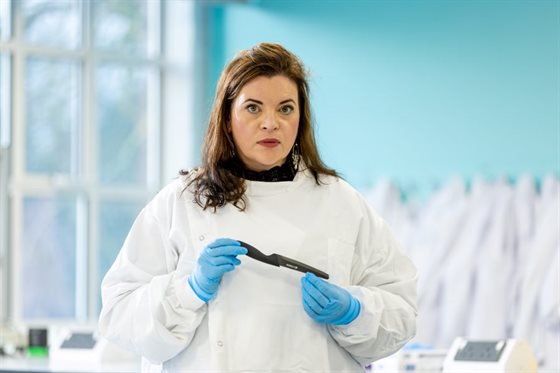
Leisa’s appointment reflects her internationally recognised research into knife safety, including pioneering studies into the impact of blade design on injury risk. Her work has shown that round-tipped knives are significantly less likely to penetrate clothing and cause harm compared to traditional pointed blades.
That research underpinned a major initiative launched in January, which saw DMU become the UK’s first Safer Knife Campus, replacing all pointed blades across with rounded alternatives to help reduce the risk of injury and promote wider behavioural change.
The initiative has been developed in collaboration with campaigners including Leanne Lucas, a survivor of the 2024 Southport attack, who has since become a prominent advocate for reducing knife harm and promoting safer knife design through her Let’s Be Blunt campaign. She partnered with Leisa to help raise awareness of the risks associated with pointed blades and to encourage wider adoption of safer alternatives.
Through her new role on MILLWEC, Leisa will contribute her expertise to national discussions on injury prevention and public safety, helping to shape policy and practice at the highest level.
Leisa said: “Being part of this committee is an excellent opportunity to take my research beyond academia and into policy, helping to inform evidence-based decision-making at a national level.
“My work has consistently shown that simple design changes, such as adopting round-tipped knives, can have a meaningful impact on reducing harm. I look forward to contributing to discussions that can help drive the adoption of safer approaches and ultimately reduce injury and save lives.”
Her appointment further strengthens DMU’s reputation for research with real-world impact, particularly in areas where science, public policy and community safety intersect.
Posted on Thursday 23 April 2026