A device that can be retrofitted to older log burners to prevent them from spreading harmful toxins in homes is being developed by a research team at De Montfort University Leicester (DMU).
The device, known as the Helixtractor, sits in a chamber that is retrofitted to existing devices. It has a heat recovery coil that creates a small whirlpool, which transports the toxins out of the firebox and into the flue chimney, where they get extracted from the plume.
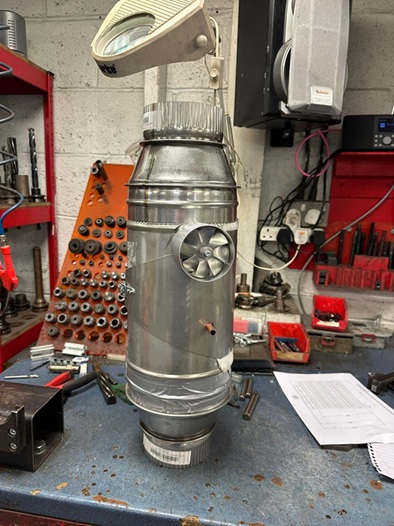
Cooler air from the room is sucked into the chamber through the vent and combines with the hot air being pulled up into the chamber by the coil. That warmer air heats the cold air, which is then allowed to escape back into the room through an outlet near the top of the chamber.
The project has received government funding from the Department for Environment, Food & Rural Affairs (DEFRA) via the Innovate UK Small Business Research Initiative scheme.
The team, led by Dr Abhishek Tiwary and DMU’s Drs Dani Harmanto, Neil Brown and Hafiz Ali from School of Engineering, Infrastructure and Sustainability, has been working with Carron Heating, to develop and test the Helixtractor.
Dr Tiwary said: “The Helixtractor has been subjected to extensive lab-testing and field trials, demonstrating its innovative retrofittable capabilities for improving the environmental performance of existing wood burning stoves, with reduced emissions of harmful pollutants alongside better retention and distribution of warmth.
“Contrary to prevalent heat recovery units currently available in the market, this technology is fully operational without electrical power source and also distributes heat more evenly around a room.
“When the burner is not in use, the harmful particles trapped inside the copper compartment are not warm enough to be airborne, so that can be taken off, cleaned and put back. We’re just exploring how often people need to clean that trap.”
Nearly two million homes in the UK are now estimated to have log burners, and as temperatures start to fall, more people will be using them to warm their homes and save on heating bills.
The burning of wood, however, produces harmful pollutants called particulate matter 2.5 and 1 (PM2.5 and PM1), a sticky, soot-like particle that can attach to other harmful chemicals from domestic wood burning and can increase the risk of serious health problems, including asthma and cardiovascular disease.
When in use, wood burners can release these air pollutants into both the indoor space and the surrounding neighbourhood.
Harmful PM2.5 particles tend to escape from the log burner when the front of the stove is opened while it is in use, for example, when adding more wood to the burner.
Solid fuel burning also produces several volatile organic compounds/semi-volatile organic compounds (VOCs/SVOCs), some of which can be particularly damaging to human health.

Burning wood and coal in homes contributes to about 2,500 deaths a year, according to a 2025 report from Global Action Plan and Hertfordshire County Council.
A 2025 report from the Royal College of Physicians showed that domestic burning is now responsible for 20 per cent of UK emissions of PM2.5 in 2023, with wood burners in homes producing 11 per cent of the country’s PM2.5 emissions in that year.
And while regulations introduced in 2020 ensure all new log burners meet environmental standards, older stoves are not required to be updated.
Brian Athey, Director of Carron Heating and who worked with Dr Tiwary on the device, said: “Based on results from both controlled workshop evaluations and extensive field trials, we are confident in the Helixtractor’s positive environmental impact.
“Its innovative, retrofittable design offers a unique solution for improving the environmental performance of both newly installed and legacy wood-burning stoves.
“Crucially, the Helixtractor’s passive design eliminates the need for electrically powered air pumps, which are often difficult to install and can introduce unwanted noise within residential environments.”
Posted on Friday 12 December 2025