A Game Art graduate from De Montfort University Leicester (DMU) has earned national recognition for a richly detailed virtual world she created as her final-year project.
Shannon Sage, who graduated this summer with a first-class honours degree in Game Art, was named a finalist in the Artist category of the 2026 TIGA Outstanding Graduate of the Year awards, organised by the trade association representing the UK video games industry.
She also won DMU's own Andrew Clay Competition Prize for the Best Final Year Project across Game Art, Animation and Graphic Arts.
Shannon says learning the technical skills required to create sophisticated 3D environments for computer games was a challenge, particularly in the early stages of her degree.
"The course didn't come naturally to me especially since my computer skills were trash," she said. "However, my determination kept me going, and I pushed myself to make every project better than the last, sometimes I even spent 12 hours a day on a project until I got it right."
She also has her own views on what it takes to develop as an artist.
"Personally, I believe that the term 'talent' is a strange word, as it implies that a person's abilities are more naturally gifted, overshadowing the time and effort put into a skill," she said.
Shannon was studying for a Foundation Diploma in Fine Art and Design at DMU when she had the chance to attend presentations introducing the university's degree courses. One presentation in particular caught her imagination.
"It was during the Game Art presentation that I was immediately captivated by the work showcased, and I knew that this was the field I wanted to pursue," she said.
"As someone with a background in fine art, I saw Game Art as an opportunity to expand my artistic abilities, develop new technical skills and adapt to the evolving demands of the industry."
Like many students joining DMU's Game Art course, Shannon had no previous experience of 3D modelling. She saw the degree as a chance to challenge herself beyond traditional art while developing the skills needed for a career in the increasingly digital creative industries.
Her determination and hard work paid off with Snack Shack Alley, a richly detailed virtual environment inspired by the acclaimed video game Stray and the imaginative artwork of artist Sheng Lam.
The project demonstrates the skills of a professional environment artist – someone who creates the virtual worlds, buildings, objects and atmospheric settings that players explore in computer games.
Shannon used carefully controlled lighting, colours and textures to make her fictional world feel lived-in and believable.
Warm lighting creates a welcoming atmosphere in an environment that is deliberately aged and rundown, suggesting a place that is nevertheless well-loved by its community. Cooler blues and greens signal restricted spaces and create an unsettling contrast.
"I believe that my carefully considered colour palette helped my final project stand out, with each colour chosen to create a specific atmosphere and influence the player's perception of the environment," she said.
"I wanted to create a visually engaging scene that rewards exploration and maintains the player's interest through its details and atmosphere."
For Shannon, the national recognition and university prize have given her greater confidence in her abilities.
"I am very proud of these achievements, and having my work recognised in this way means a great deal to me. It has also given me greater confidence in my artistic abilities."
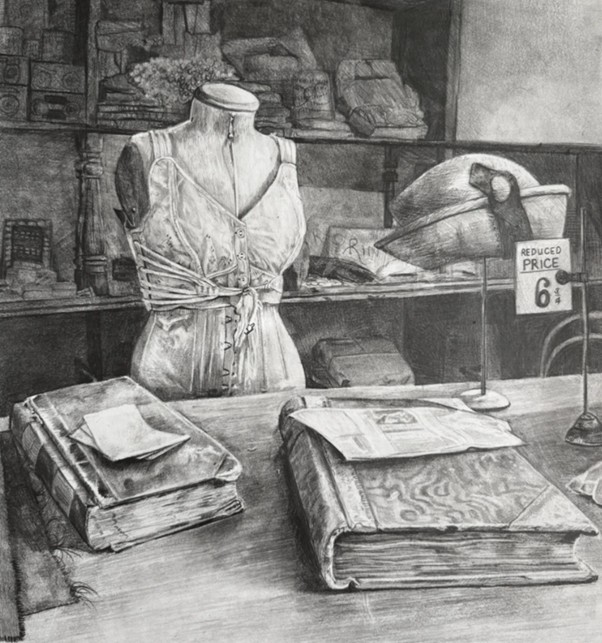
A traditional pencil drawing by Shannon.
She credits the teaching team at DMU with helping her develop both her technical abilities and the critical thinking needed to recognise weaknesses in her work and find ways to improve it.
Craig Mooney, Game Art Course Leader at DMU, said the course was designed to turn artistic ability into the specialist skills required by the games industry.
"We don't expect students to arrive knowing how to use 3D modelling software – that's what we're here to teach them. What matters at the outset is their artistic ability, creative potential and willingness to learn.
"But as Shannon herself recognises, artistic ability isn't simply a gift that you're born with. It's something you nurture and develop through practice, hard work and a determination to keep improving.
"Shannon has demonstrated exactly that. She's worked incredibly hard to develop her artistic and technical skills, and her final project shows a real understanding of how colour, lighting and detail can create a convincing world and tell a story. Her TIGA nomination and Andrew Clay Prize are thoroughly deserved."
The recognition comes at a challenging time for new entrants to the games industry, with graduates facing fierce competition for jobs and growing uncertainty about the impact of artificial intelligence.
Shannon is particularly sceptical about generative AI, arguing that relying on it to develop creative ideas risks undermining the independent thinking and originality that artists bring to their work.
DMU's Game Art BA (Hons) is fully accredited by TIGA and recognised by ScreenSkills. Earlier this year it was also awarded Gold Academic Partner Status by Epic Games, recognising its teaching and expertise in Unreal Engine, the technology used to create some of the world's best-known computer games.
Posted on Wednesday 21 October 2026