Poet, activist and De Montfort University Leicester (DMU) graduate Ty’rone Haughton has added his lyrical voice to the growing Art Not Evidence campaign to limit the use of artistic expression, and rap music in particular, as prosecution evidence in criminal cases.
A new four-minute video, filmed at DMU, cuts between Ty’rone standing suited in a courtroom dock, and roaming the cells in a grey prison tracksuit, as he recites his piece 16’s to Life – the title refers to the classic 16-bar structure of a rap verse, but also to the lengthy sentences handed down in the kinds of gang violence cases where rap and drill is being used as prosecution evidence.
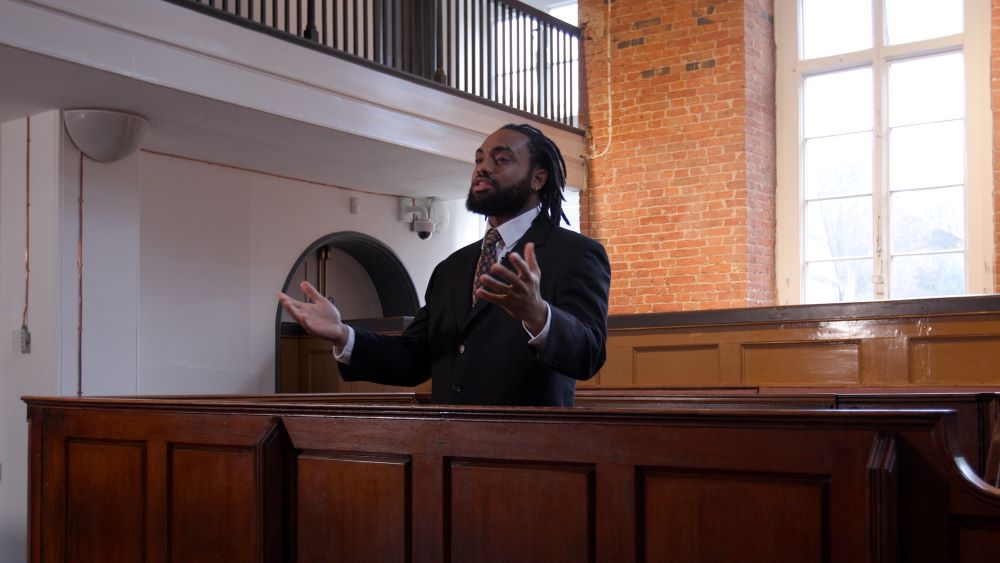
16’s to Life was specially written for Art Not Evidence, a UK coalition of lawyers, academics, and artists fighting the misuse of rap and drill lyrics as evidence in UK criminal courts.
In it, Tyrone makes the case that rap and drill are art forms through which children and young black men express themselves and reflect the places, and the culture, in which they live. It includes the line: “Most times it's fictitious, writing fantasies, creating characters and narratives inspired by local happenings, because art imitates life – not the other way around.”
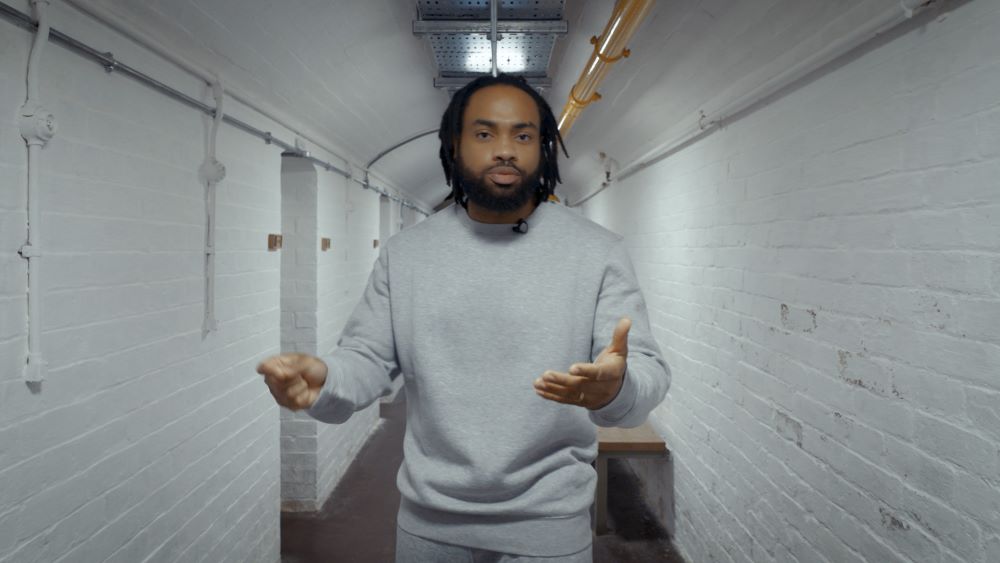
The Art Not Evidence campaign is a response to a recent startling increase in the number of cases where prosecutors present the act of writing, performing, or even enjoying, rap and drill music and videos as evidence of gang membership and of propensity to commit violent crime. Such evidence is often used in an attempt to draw people on the periphery of an offence into a prosecution on the basis that they were part of a gang-related conspiracy or joint enterprise.
Ty’rone, who graduated from DMU with a degree in law before he became a poet, has a different perspective.
“I like to use my poetry to advocate for people, or to speak about injustices and about justice," he said. "It was while studying law that I found poetry and I don't think the two things are necessarily so different. Lawyers deal with justice, advocacy and words. I just wanted to use my words to do the same thing. So kind of parallel to the law.”
Ty’rone’s early love for words and language grew out of rap music, and specifically from exposure to Eminen, after he traded with a neighbour for a copy of the 1999 album The Slim Shady LP, which includes several songs in the ‘horrorcore’ rap genre involving lyrics about killing.
Singing about killing is by no means exclusive to rap and its sub-genres. Often called ‘murder ballads’, songs about killing and violence have always been an important part of vocal music - from the blood-soaked ballads of England and Scotland as far back as the Middle Ages, to more recent mainstream music by everyone from The Beatles, Jimi Hendrix, Nancy Sinatra and Bob Marley to The Killers, Nick Cave and Kylie Minogue. And even current global superstar Taylor Swift, whose 2020 track No Body, No Crime is a classic murder ballad.
As in rap and drill, murder ballads often use violent lyrics, and hyperbole as storytelling tools.
Country music in particular has always had a strong dark seam of murder ballads running through it – perhaps the best-known examples are Johnny Cash’s Cocaine Blues, Delia’s Gone, and I Hung my Head (among many others), and Chicks’ (formerly Dixie Chicks) huge hit Goodbye Earl.
This is a history of which Ty’rone is well aware, thanks in part to his own Jamaican roots, and to the somewhat surprising fact that country music is hugely popular and deeply embedded in Jamaican culture.
“It's naughty, what they’re singing about in a lot of country music,” said Ty'rone. “But you don't hear much about that, and it's never criminalised.
“But some boys in hoodies who have absolutely no money, and no prospects, just passing a mic around and saying things that they see happening. They're not taking part in it. They see it happening, or they make it up to create a kind of armour, or a persona around themselves. And they’re penalised, and policed and told they are not allowed to express themselves in these ways.”
Tyrone believes that the prosecutors and judges who accept engagement with rap or drill as evidence of bad character, or criminality, are simply refusing see the music for what it really is and failing to understand the cultural context or the nuances of what, in the vast majority of cases, is fictional narrative built up around events that may have happened in their street, or their post code area.
“I just don't think they care enough to look beneath the surface,” he said. “But what I understand from studying law is that in order to convict someone, you need to be able to place them in a time and in a place, with a motive. It can't be a lyric in a song. It can't be a music video.
“We don’t think Tarantino is a murderer because there’s murder in all of his films, do we? We don’t believe Scorsese is a gangster because there are gangsters and violence in his films.
“But it sells. People always like to watch it. I think it’s attractive because it's so far out there, so far from the norm. People love these things because they’re completely jarring against everything that you know to be the moral, societal code of how you behave.
“Take Goodfellas - I love that film, but would I ever take part in that? No. Would I watch it over and over again? Absolutely. It’s the same in music, or it should be – that is what Art Not Evidence is about really.”
Keir Monteith KC ,co-founder of the Art Not Evidence campaign, said: “The first time I saw 16’s to Life, it just blew me away. It is a phenomenal piece of artistry and should become compulsory viewing for judges, lawyers and the police."
The criminal barrister encountered the poet through the Stephen Lawrence Research Centre (SLRC) at DMU which funded the making of 16s to Life.
In May last year Tyrone performed ahead of Keir’s SLRC Annual Lecture 2025, which he gave on the subject of the misuse of rap and drill as evidence of bad character or gang membership.
A central aim of Art Not Evidence is to persuade the government to enact new legislation. Already drafted by the campaign, The Criminal Evidence (Creative and Artistic Impression) Bill which would limit the admissibility of evidence related to a person’s creative and artistic expression in the criminal courts of England and Wales.
Without it, according to Keir, progress towards getting the courts to deal with issues of racism and stereotyping will be too uncertain, and too slow.
“We need this legislation because the use of lyrics and music, of drill music in particular, is still prevalent,” he said. “And unfortunately, without legislation, we are not going to be able to persuade enough judges and prosecutors to stop doing it.”
“Creative expression does not exist in a vacuum," said a spokesperson from the Stephen Lawrence Research Centre at DMU.
"When art is removed from its cultural and social context, it can be dangerously misunderstood, with real consequences for individuals and communities,- this film powerfully reminds us why institutions must approach creative work with care, understanding and responsibility."
Posted on Wednesday 21 January 2026