DE MONTFORT University is collaborating with a series of NGOs on climate adaption and sustainability – including a £1.3 million project in Leicester’s most deprived communities.
The three-year project, which launched in late 2025, will work with five grassroots NGO partner organisations to embed sustainability, cut emissions, improve resilience and influence climate policy.
Leicester Environmental Action and Future (LEAF) is funded by the National Lottery Community Fund and aims to be a template for similar initiatives throughout the United Kingdom.
DMU has partnered with five NGOs in Leicester – One Roof Leicester, Saffron Acres, ZamZam Unlimited, the Somali Development Services, and Leicester Nirvana – to deliver a comprehensive programme of climate adaption.
More than 150 staff and volunteers at the partner organisations will be trained in carbon literacy and at least 1,500 residents will be involved in sustainability activities.
Regular public events, youth climate education programmes and an annual DMU-hosted climate conference are also planned. A Climate Adaption Partnership Hub will be based on DMU’s Leicester campus to co-ordinate the programme.
Part of the project will also see a series of other NGOs based in Leicester trained in carbon literacy and by the end of 2025 a total of 24 organisations had signed up for the scheme.
Climate adaption work with the NGO Carbon Literacy Trust
This carbon literacy training is an extension of work being done with DMU staff and students in collaboration with the NGO, the Carbon Literacy Trust (CLT).
By the end of 2025, DMU passed the 700 milestone for the number of staff and students that have been trained in carbon literacy under the CLT programme.
The training has included the university's senior leadership and the Board of Governors and the trust has declared DMU a Carbon Literate Organisation.
Carbon literacy training is designed to raise awareness of the carbon costs and climate change risks, impacts, mitigation, adaptation, impact reduction and early warning systems.
It also equips individuals with the knowledge, capacity, and motivation to take action to reduce emissions on personal, community, and organizational levels.
The training covers topics such as climate change, carbon footprints, and practical steps individuals can take to contribute to a more sustainable future.
Overall, it aims to empower participants to understand and communicate about climate change effectively.
DMU's Sustainability Manager Karl Letten said: “Carbon literacy is one of the most important education programmes we run in showing people the climate change risks and impacts.
“Many people come away from the training with ideas for making a difference in both the workplace and also at home. We feel this really does make a difference.”
Climate adaption work with the NGO SOS-UK
DMU also collaborates with the NGO SOS-UK (Students Organising for Sustainability) group for its annual SDG Teach-in, where universities across the world aim to make links to one or more of the United Nations Sustainable Development Goals within their taught courses.
In 2025, more than 94 institutions took part across 17 countries on five continents, 1,028 educators were involved and more than 118,00 students reached.
DMU won the gold medal and was the number one university in the world for the number of educators who pledged to include the SDGs in their course and also number one for the number of students reached by the sessions.
The collaboration with SOS-UK also extends to the Responsible Futures programme - a structured approach to embedding social responsibility, climate adaption and sustainability across a university’s curriculum.
DMU’s participation is a partnership between the university, De Montfort Students’ Union and SOS-UK and is a collaboration that has been going on since 2018 with the university twice being re-accredited by the programme.
The Responsible Futures programme notes on its website that DMU has ‘an ongoing commitment to excellence…and embedding sustainability into all aspects of student learning’. DMU now has sustainability and the SDGs embedded into more than 200 modules.
Climate adaption work with the NGO Canal and River Trust
DMU has also worked for several years on projects with the Canal and River Trust, an NGO responsible for the waterways around Leicester and the rest of the UK.
The Stop Plastics Getting into the Ocean event mobilises students to clean-up the River Soar and Grand Union Canal through Leicester and the adjoining riverbanks.
The event not only removes plastics and other rubbish from the waterways but acts to give students a practical education on the need for climate adaption.
Dr Mark Charlton, Associate Professor of Sustainability and head of the SDG Impact Hub at DMU, said: “All this work we do with NGOs, and many other organisations, is about educating our staff, students and the wider community about climate adaptation, sustainability and resilience.
“We are proud of our work over many years with NGOs which has reached its climax with the LEAF project working with five partner NGOs and many more subsidiary projects across Leicester to educate the wider community and beyond on climate adaption.”
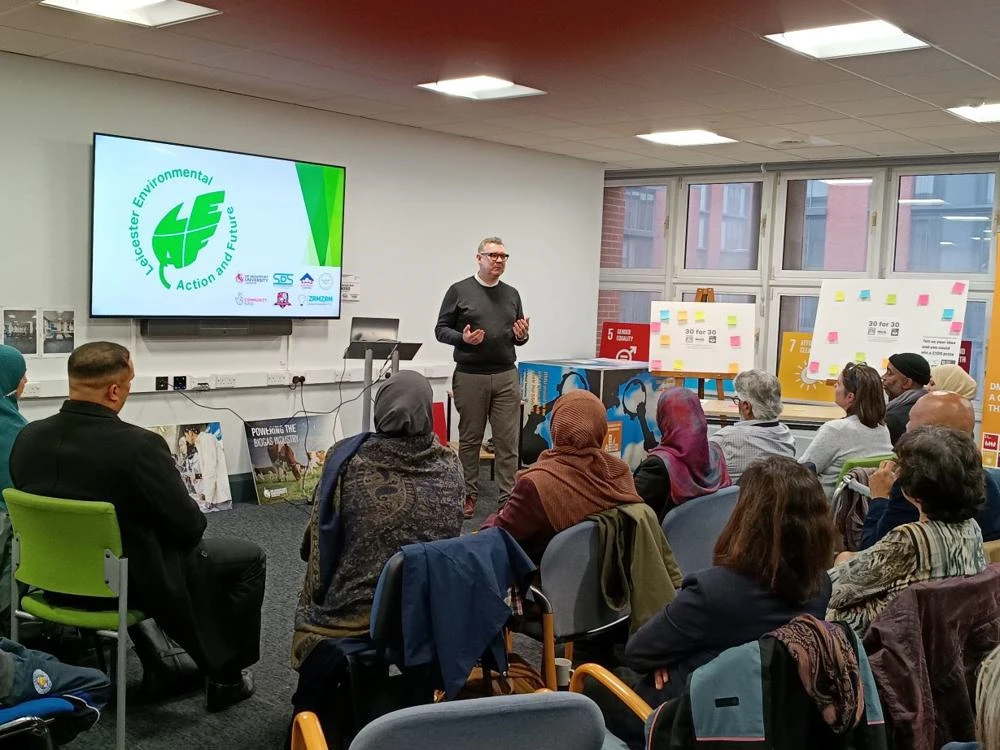 The launch of the LEAF climate adaption project at DMU earlier in 2025