DE MONTFORT University is actively working with organisations around the world planning for climate change disasters and ways of mitigating their affects – but also carrying out work both locally and regionally.
The United Nations appointed DMU in 2025 as the global academic hub chair for one of its Sustainable Development Goals – SDG 11 Sustainable Cities and Communities.
One of the key mandates from the UN in the three-year role will be to work with partner universities on target 11.5 Disaster Risk Reduction of SDG 11.
This target calls for “by 2030, significantly reduce the number of deaths and people affected by disasters, focusing on protecting the poor and vulnerable.”
DMU will be working with its three vice-chairs in Cologne, Germany (teaching and education); Ho Chi Minh City, Vietnam (outreach and partnership); and Port Alegre, in Brazil (research) on a programme of activity to address the disaster reduction target.
The activity planned in initial plans for the SDG 11 global hub include…
- Research into flooding and disaster risk reduction identify as the primary focus;
- Internal research groups working with partners and focused on disaster risk reduction alongside poverty, economic issues, and health;
- A collaborative forum between the public sector and universities discussing best practices for resilient cities and cooperation on migration issues;
- And masterclasses to discuss flood resilience solutions and urban development oriented toward public transportation.
The DMU global academic hub chair lead Dr Mark Charlton said: “The United Nations Academic Impact in awarding us the global hub chair made it clear resilience and disaster reduction was a priority and it is one we will embrace.
“The role of the four universities will be to promote awareness, research, outreach and teaching in all areas of SDG 11, but with the UN mandate of 11.5 and disaster risk reduction as a priority.
“Through of work we will aim to promote best practice and with the UN disseminate the information through its thousands of affiliated organisations and governments around the world to help mitigate the damage done by disasters.”
One of DMU’s main fields of work before taking on the global chair for SDG 11 was working on the effects of forced migration and displacement, which includes a growing number of climate refugees.
Forced migration, displacement and climate refugees
The Together campaign was spearheaded by DMU and involved a network of 100 higher education universities around the world working on the issue with the UN, governments and NGOs.
In 2019, the university became the global academic hub for the UN’s SDG 16 Peace, Justice and Strong Institutions to continue its work on the forced migration and climate change.
DMU’s work on climate change and forced migration was recognised with official observer status being granted by the United Nations Framework Convention on Climate Change (UNFCCC).
At COP 28 in Dubai in December 2023, DMU was the only university in Europe to have a dedicated pavilion within the Blue Zone, where world leaders were meeting to discuss action on climate change.
At COP 29, in Azerbaijan, and COP 30, in Brazil, university delegations were again in the Blue Zone talking to government representatives about its research and work on climate change and work on disaster reduction.
Dr Charlton added: “Although our work with the UN has an international dimension, much of the real-world applications and research is done locally and regionally.
“What we do in our home communities provides that best practice that can inform our UN role and shows local is just as important as global.”
Work is going on locally and regionally
The university is working with a series of local authorities, businesses, voluntary, community and social enterprises, universities and education sectors, to drive local action and work towards a shared set of environmental goals.
DMU was one of the first organisations to sign a newly-launched pact aiming to accelerate Leicestershire’s goal to become a net zero county by 2045.
The Climate and Nature Pact aims to bring the organisations involved will share energy saving strategies and work together more strategically to make the region greener.
This builds on the work of the Universities Partnership which sees Leicestershire’s universities – DMU, University of Leicester and Loughborough University collaborating on tackling climate change.
The institutions launched the GreenerFuture initiative that builds on the Universities Partnership’s commitment to sustainability by focusing on environmental education and practical solutions for sustainable development.
The focus of the project is to decarbonise and breakdown non-technical barriers to deliver net zero. GreenerFuture provides fully funded support for:
- ·Businesses – Helping companies adopt sustainable practices, reduce emissions, and improve energy efficiency.
- Residents and communities – Offering guidance on sustainability efforts at a local level, including energy-saving strategies.
- Policymakers – Supporting local councils and decision-makers in implementing effective climate policies.
Similar work has been on-going with Leicester City Council since 2019 when the local authority declared a climate emergency, which included the establishment of the Leicester Resilience Hub that saw a series of projects in 2025 to mitigate the effect of climate change.
DMU has worked with the city on a wide range of climate action projects since the 1980s and earlier in 2024 supported the Climate Ready Leicester Guide for the 400,000 residents of the city.
This aims to show how residents can make a difference through their choices on housing, transport, heating and green spaces to mitigate the effects of climate change.
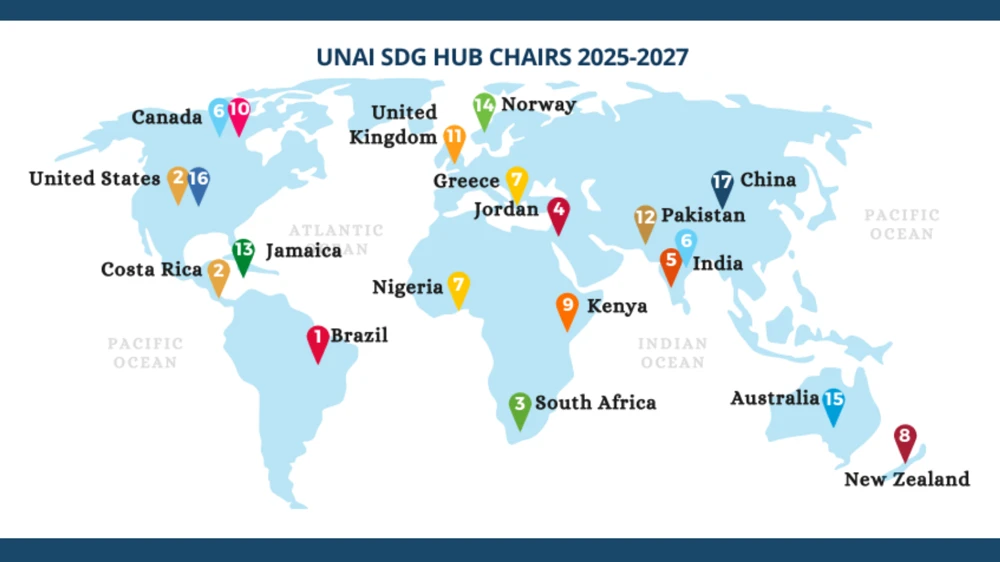 The UNAI global academic hub chairs around the world