Two students from De Montfort University have travelled to Japan as part of a fact-finding mission to bolster Charnwood Forest’s application to become a UNESCO Global Geopark.
Becky Wilson and Natalia Stachowiak set off on 5,000 mile journey to the city of Nagaoka to learn about Japan’s cultural attitude towards sustainability, and explore the nearby Itoigawa UNESCO Global Geopark.
Here is Becky's blog from the trip...
Discovering Japan: A journey from Tokyo to the Sea of Japan
Japan has always been one of those dream destinations that feels both futuristic and deeply traditional — and our trip proved exactly that. We spent an unforgettable week exploring everything from Tokyo’s neon-lit streets to the tranquil coastline of Itoigawa, and along the way we experienced just how seamlessly Japan blends innovation, culture, and sustainability.
Touchdown in Tokyo
We landed in Tokyo full of anticipation (and a little jet lag). The first thing that struck us wasn’t the skyscrapers or the crowds — it was the cleanliness. The streets were spotless, even in the busiest areas, and bins were few and far between! It was a perfect introduction to Japan’s culture of respect and responsibility, where everyone takes care of shared spaces.
Getting around was a breeze thanks to Tokyo’s efficient public transport. The trains ran with clockwork precision, and the stations were clean, well-organised, and easy to navigate. Using the JR Pass and metro cards, we could travel anywhere without needing taxis or rental cars — an eco-friendly bonus that makes Tokyo one of the most sustainable cities we’ve ever visited.
Exploring markets, temples, and parks
Our days were filled with exploration. We wandered through Tokyo’s bustling markets, sampling street food and admiring how seamlessly old traditions coexist with modern trends. The Asakusa Temple area was a standout — incense smoke drifting through the air, the hum of visitors, and the contrast of ancient architecture surrounded by urban energy.
We also spent a peaceful afternoon in Ueno Park, an oasis of calm in the heart of the city. The pathways were lined with trees, koi ponds shimmered under the sun, and we even spotted families picnicking neatly on tarps — no litter, no noise, just quiet enjoyment.
A different view from Tokyo Skytree
No trip to Tokyo would be complete without seeing the city from above. The Tokyo Skytree offered breathtaking panoramic views — endless city lights stretching toward the horizon. From up there, you could truly appreciate the order and balance of Tokyo’s urban design. Even the sheer density of the city felt harmonious, thanks to smart planning and efficient use of space.
A trip to Itoigawa – The Jade Coast
After soaking up Tokyo’s buzz, we took the iconic Shinkansen (bullet train) west to Itoigawa, a peaceful coastal city on the Sea of Japan. The ride itself was an experience — smooth, silent, and incredibly fast, with the Japanese countryside whizzing by in perfect snapshots of rice fields, villages, and mountains.
Itoigawa is famous for its Jade Coast, where you can find naturally polished jade stones along the beach. We visited the Jade Museum, learning about the region’s history and how jade has been part of Japanese culture for thousands of years. Standing on the shoreline, with the Sea of Japan stretching endlessly before us, it felt worlds away from Tokyo’s pace — yet connected by the same sense of care and respect for nature.
Micro pigs and modern quirks
Back in Tokyo, one of the most memorable stops was the micro pig café — a uniquely Japanese mix of cuteness and calm. Sitting with tiny pigs curled up beside us while sipping coffee was both adorable and oddly relaxing. It captured the playful, creative spirit of modern Japan that makes it such a joy to explore.
Reflections on a sustainable city
What stood out throughout our journey was Japan’s quiet commitment to sustainability. From recycling systems and public transport to the cultural emphasis on respect, everything felt intentional. People moved with consideration — no loud voices, no pushing, no littering. It wasn’t about strict rules; it was simply part of everyday life.
We left Japan feeling inspired — not just by the temples, the technology, or the food (though the sushi alone deserves its own chapter), but by the balance between progress and mindfulness. Japan showed us that a city can be modern, efficient, and sustainable, without losing its heart.
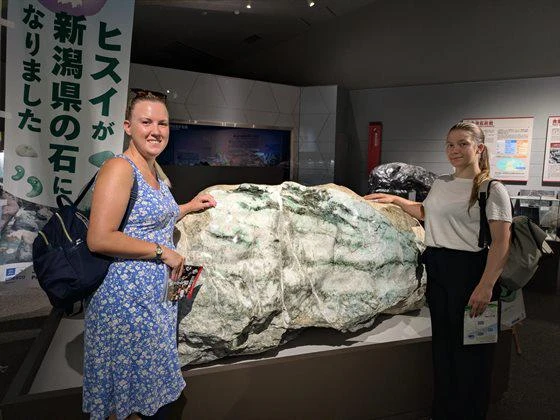 Becky and Natalia with a lump of jade rock during their visit to the Fossa Magna Museum