DE MONTFORT University’s campus in Leicester has undergone significant changes over the past decade but all the construction has been on brownfield sites.
The campus is within the historic heart of Leicester and all construction work has needed to be in keeping within the area's unique environment – and it will be the same for the next 10 years.
The 2025-2035 Masterplan will involve only brownfield site development and bring major energy savings and a 47% reduction in carbon emissions.
The major developments in the previous 10-year plan saw work on the Leicester Castle and Trinity House.
Both of these buildings have been carefully and sympathetically internally remodelled so that their history has been kept intact as part of a £150 million masterplan for the redevelopment of the campus to create a modern university.
The 11th century Leicester Castle with its main hall, entrance arch, walls and cobbled streets is now home to DMU’s business school
The £5 million project to create the Leicester Castle Business School was the refurbishment of the historic Great Hall keeping its old court rooms, which were repurposed as meeting rooms, and the cells in the basement.
Trinity House, built in 1331 as the city’s first hospital, is now the administrative headquarters of the university, with the old chapel converted into an event space.
The construction of new buildings has all been on brownfield sites, either with the redevelopment of existing estate or the demolition of outdated buildings and their reconstruction.
DMU’s latest project has seen The Yard, a £5.5 million extension to the Hugh Aston Building, becoming fully operational in 2025 .
The 22,000 square metres of additional learning space across four floors was built on a brownfield site in space between existing buildings that was unused.
In addition to much-needed extra learning space and resources, the extension also features a space for commercial activities and a luxury balcony on the top floor overlooking the Leicester campus.
All of DMU’s £150 million masterplan to recreate a modern university has been reconstruction or refurbishments on existing brownfield sites.
The impressive Vijay Patel Building, which houses much of the university’s arts and design department, was constructed after the demolition of the old and outdated Fletcher complex on the same site.
The new Campus Centre, home to the De Montfort Students’ Union, a café, meeting place and shops, came from the redesign and refurbishment of the existing building.
The construction of the new QEII Sports Centre was on the site of an old pub and car park and The Venue exhibition space and halls was built by the redevelopment of the old John Sandford Sports Centre.
All the construction work has been carried out with the need for green and open spaces in mind. Plazas were created by Leicester Castle, the Hawthorn Building and Hugh Aston Building as well as public open space along the pedestrianised Mill Lane in front of the Vijay Patel Building.
In the next 10 years, the Campus Masterplan 2025-35 will be about transforming existing buildings with no construction on green spaces.
There will be the demolition of six outdated campus buildings to reduce energy consumption and cut carbon emissions by 47% and the refurbishment of the John Whitehead Building to house staff displaced by the demolition.
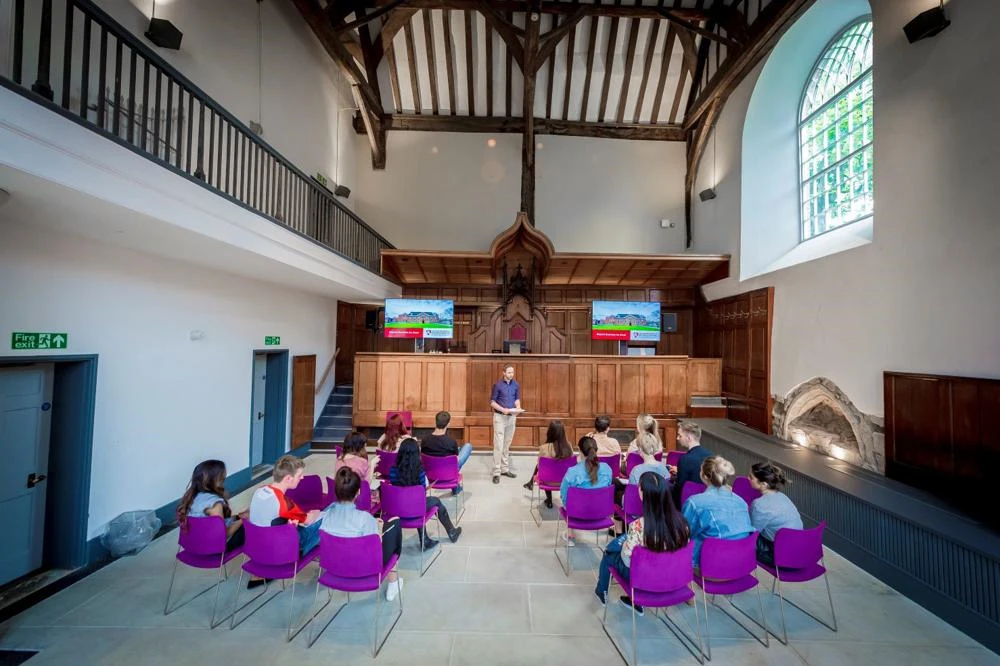 The courtrooms of Leicester Castle have been transformed into meeting rooms